UX Design Agency in San Francisco: 11 Bay Area Firms Compared by Address, Rate and Fit

UX Design Agency in San Francisco: 11 Bay Area Firms Compared by Address, Rate and Fit

Eleven San Francisco and Bay Area UX design agencies compared by published address, hourly rate, project minimum and Clutch rating, plus what a Bay Area engagement actually costs against a remote one.

UX Design Agency in San Francisco: 11 Bay Area Firms Compared by Address, Rate and Fit

UX Design Agency in San Francisco: 11 Bay Area Firms Compared by Address, Rate and Fit

Eleven San Francisco and Bay Area UX design agencies compared by published address, hourly rate, project minimum and Clutch rating, plus what a Bay Area engagement actually costs against a remote one.

Most San Francisco UX lists do not check addresses. One ranking firm publishes a Palo Alto address while calling itself San Francisco based. Another puts its own two addresses on the same page. Every firm below has a published Bay Area address, printed.

Eleven Bay Area firms, real addresses, published rates, costed against remote.

TL;DR

  • Most lists for this search do not check addresses. One firm ranking on page one calls itself San Francisco based on a site whose only published address is in Palo Alto. Another publishes two different addresses for itself on the same page. A third list puts firms headquartered in Vancouver, New York and Boston on a San Francisco shortlist.

  • Published hourly rates in the Bay Area run $100 to $300, and the $150 to $199 band covers most of the market. Nothing with a verified local address publishes below $100.

  • The minimum is what actually gates the conversation, and it ranges from $25,000 to $50,000 across firms that publish one. Three of the eleven publish nothing at all.

  • Eleven firms below have a published Bay Area street address. Four well-known names were cut for failing that test, and we name them and the reason.

  • The same eight-week engagement costs roughly $72,000 to $95,500 at Bay Area rates and $24,000 to $47,500 remote, on published rate bands. Whether that gap is worth paying is a real question, and it is answered further down rather than assumed.

Search for a UX design agency in San Francisco and the first two results are agencies rather than articles. The lists in between have a different problem.

One of them puts ten firms on a San Francisco shortlist without printing a single address, and three of those firms are headquartered in Vancouver, New York and Boston. The firm sitting fifth on this search describes itself as "a San Francisco-based creative agency" on a site whose only published address, including on its own legal privacy page, is on Page Mill Road in Palo Alto. And one agency's own article about the best San Francisco agencies gives itself an address that the footer of that very page contradicts.

None of that is hard to check. It takes about a minute per firm, and nobody ranking for this search has done it.

So this page has one rule. Every firm below publishes a Bay Area street address on its own website, and that address is printed in its entry. Where the address is thin, a suite number with no building, or a page that calls its locations "meeting locations" rather than offices, that is said plainly too, because it tells you something.

Groto is our own studio. We are not a San Francisco company, we are a remote team, and we have said so in our entry rather than describing ourselves as serving the Bay Area. The list is ordered by published project minimum, lowest first, so position reflects a published number and nothing else. No firm paid for placement.

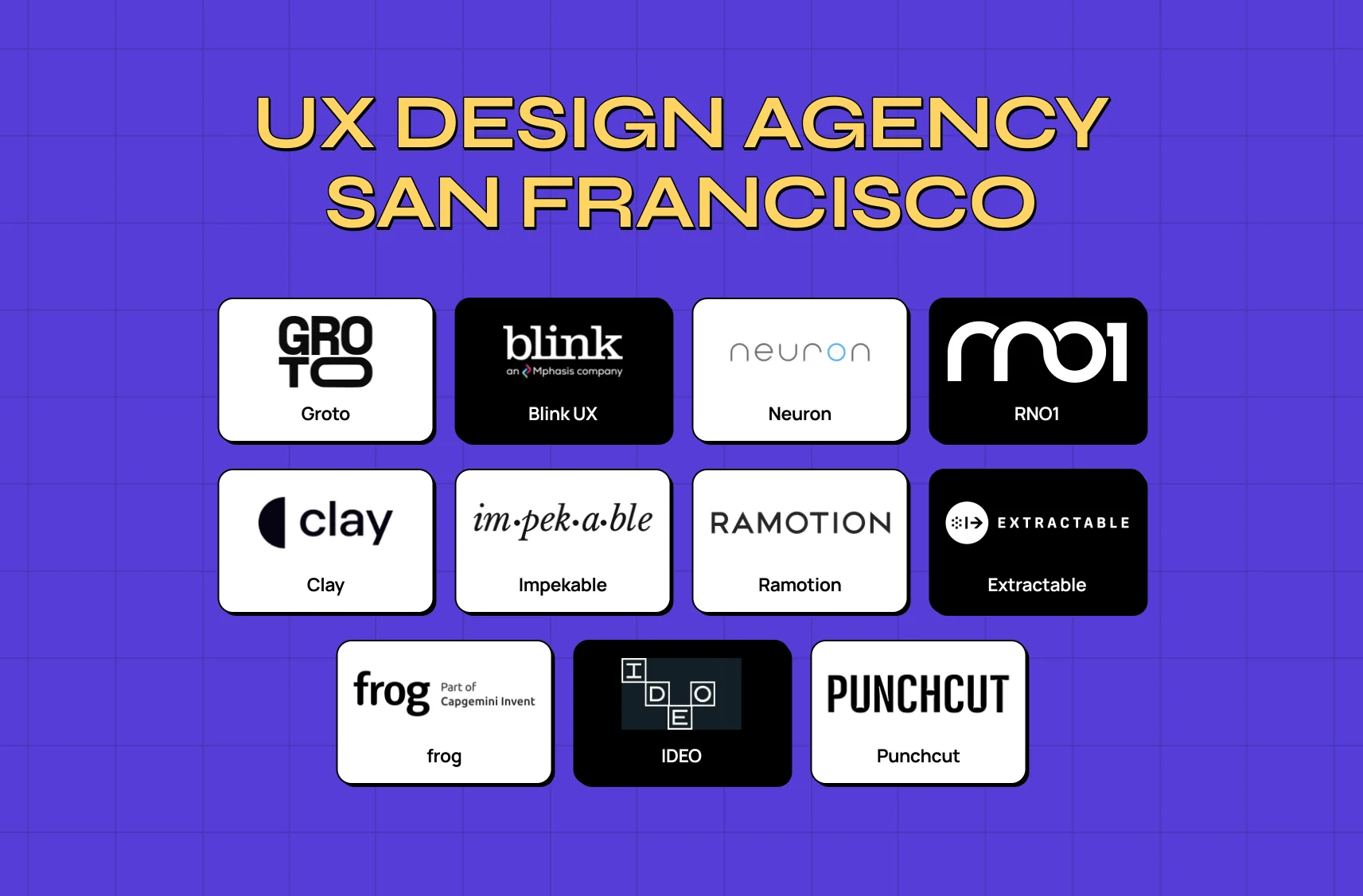
Quick Comparison: San Francisco and Bay Area UX Design Agencies

#

Agency

Published address

City

Founded

Team

Hourly

Minimum

Rating

1

Groto

Remote

Remote

2021

10-49

$50 to $99

$5,000+

4.9

2

Blink UX

575 Market St., Suite 710

San Francisco

2000

150-200

Not published

$25,000+

5.0

3

Neuron

650 California St, Floor 7

San Francisco

2016

10-49

$150 to $199

$25,000+

4.9

4

RNO1

650 California Street

San Francisco

2010

10-49

Not published

$25,000+

4.8

5

Clay

300 Broadway

San Francisco

2009

51-100

$150 to $199

$50,000+

4.8

6

Impekable

2261 Market Street, STE 10822

San Francisco

2012

10-49

$200 to $300

$50,000+

4.8

7

Ramotion

28 Geary St, Suite 650

San Francisco

2009

10-49

$150 to $199

$50,000+

4.9

8

Extractable

400 Concar Drive

San Mateo

1999

10-49

$200 to $300

None published

4.5

9

frog

1011 3rd Street, Suite 300

San Francisco

1969

1900

$100 to $149

See entry

Not rated

10

IDEO

350 Florida St

San Francisco

1991

1320

Not published

None published

Not rated

11

Punchcut

150 California Street, 9th Floor

San Francisco

2002

51-100

Not published

None published

Not rated

Three things to read off this before the entries.

The order is not a quality ranking. It is published minimum, lowest first, with ties breaking alphabetically, and the four firms that publish no usable minimum sitting at the end. frog is the one judgement call in that rule, and since the call happens to benefit us, here is the full reasoning. Its directory profile shows a $5,000 minimum and a $100 to $149 hourly rate, on a profile carrying no reviews. Neither figure is a plausible quote from a firm of more than a thousand people inside Capgemini Invent; they read as defaults on a page nobody maintains. We have grouped it with the firms publishing nothing rather than treating a default as a price. The underlying figure is in its entry, unedited, so you can disagree with us.

The ratings do not separate these firms. Everything rated sits between 4.5 and 5.0, three firms have no rating at all, and two of the rated ones rest on fewer than seven reviews. Portfolios and reference calls will tell you more here than a star average.

The minimum is the column that matters. It is the number that decides whether a conversation happens at all, and the spread across these eleven is large, checkable and consequential in a way nothing else on this table is.

How We Picked These Agencies

A published Bay Area street address on the firm's own site. This rule did most of the work and it removed more well-known names than anything else. A city in a page title is not an address. A service area is not an address. Where a firm publishes an address but labels it something other than an office, that is noted in its entry rather than hidden.

UX or product design as a core practice, not an attachment. Two firms with genuine Bay Area addresses were dropped on this rule, and one firm on the list is flagged inside its entry because its published service mix has moved away from design. If your search is for a UX agency, a branding studio with a UX page is a different purchase.

Numbers that actually exist. Rates, minimums, team sizes and founding years are in the table where firms or their directory profiles publish them. Where nothing is published, the table says so, because a firm that will not name a number before a call is telling you something about how it sells.

Ordered by published minimum, lowest first. Ties break alphabetically. Firms publishing no minimum sit at the end. We did not adjust the order to flatter anyone, including ourselves.

One disclosure. Groto wrote this list. We are a remote studio with no Bay Area office, which is why our entry says "Remote" rather than claiming to serve San Francisco. If you want the broader national picture rather than one city, our comparison of the best UX design agencies in the US covers the market as a whole.

What a UX Design Agency in San Francisco Costs in 2026

Price by scope

What you are buying

Typical Bay Area cost

Rough timeline

Research only, no design

$20,000 to $40,000

3 to 6 weeks

A single flow redesigned

$25,000 to $50,000

4 to 8 weeks

A full product design engagement

$50,000 to $150,000

3 to 6 months

Design plus build

$150,000+

4 months and up

A monthly design subscription

Billed per month, no project minimum

Ongoing, cancel or pause

That last row is the one buyers in this market tend not to know exists. Instead of scoping a project, you hire capacity by the month and queue work against it, which suits a team with a steady flow of small briefs rather than one large redesign. It is a genuinely different purchase with different failure modes, and we have compared the providers in our guide to the best design subscription agency options for SaaS.

The most useful figure here does not come from a roundup. Ramotion publishes its own range on its own San Francisco page: $25,000 to over $100,000 for a standard engagement. That is a first-party number from a firm on this list, and it brackets the middle two rows above almost exactly.

What Bay Area firms actually publish, and what they do not

Published hourly rates across this list run $100 to $149 at the low end and $200 to $300 at the top, with $150 to $199 covering Clay, Neuron and Ramotion. Nothing with a verified Bay Area address publishes below $100 an hour.

Published minimums are $25,000 at Blink UX, Neuron and RNO1 and $50,000 at Clay, Impekable and Ramotion. Extractable, IDEO and Punchcut publish no minimum anywhere.

Five of the eleven publish no hourly rate at all. None of the eleven publishes a price on its own website. Every figure in the table above comes from a directory profile rather than from the firm's own pages, which is worth knowing before you treat any of it as a quote. If you want the mechanics of how agencies actually structure fees rather than the numbers alone, we have web design agency fee structures explained in detail.

Why two quotes for the same product differ by three times

Who does the work. A ten-person studio and a thousand-person consultancy bill differently for the same screen, and neither is wrong.

Whether research is in scope. This is the single largest swing, and it is covered below, because most buyers do not realise research is a separate purchase.

Whether engineering is included. Design plus build is a different product from design alone. Four firms on this list sell both. Most sell one. And if your product has a physical component, you are shopping in a different category again, where the leading product design studios in San Francisco include firms that design objects rather than interfaces.

Seniority mix. A $200 to $300 band usually means principals on the work. A $150 to $199 band usually means a team with a lead. Ask who specifically is on your project and for how many hours a week, and the rate starts to explain itself.

Research is a separate purchase, and most buyers do not know it

You can buy user research without buying design. Discovery interviews, usability testing, a competitive teardown and a synthesis readout are a complete engagement on their own, and for a team that already has designers, it is frequently the only thing worth buying from outside.

It matters here because it changes the quote by tens of thousands. A proposal that bundles research into a design engagement is not wrong, but it makes the two impossible to compare across firms. Ask for them priced separately and the shortlist suddenly becomes comparable.

If research is the only thing you actually need, the firms that specialise in it are a different roster from the one below, and our ranking of user research firms compares them on method, recruiting speed and timeline rather than on design output.

The same project, both ways

Nobody on this search prices the same scope locally and remotely, so here it is.

Take an eight-week SaaS onboarding redesign, two designers, roughly 30 hours a week each. That is about 480 hours.


Hourly band

480 hours

Minimum gate

Bay Area firm at the common band

$150 to $199

$72,000 to $95,520

$25,000 to $50,000

Bay Area firm at the top band

$200 to $300

$96,000 to $144,000

$50,000

Remote studio at Groto's published rates

$50 to $99

$24,000 to $47,520

$5,000

The honest reading of that table is not that remote wins. It is that the gap is roughly $50,000 on a single eight-week project, and that is a large enough number to be worth a deliberate decision rather than a default. What the Bay Area premium buys is covered below, and sometimes it is worth every dollar.

That bottom row is also the widest band in the whole market, and it is the one where quality varies most. If you are going to price the offshore option seriously rather than use it as a negotiating position, our comparison of UI UX design agencies in India sets out what separates the firms at that end on cost, city and fit.

The 11 Agencies

1. Groto

Groto homepage showing its AI-first UX design agency positioning and 4.9 Clutch rating

Address: remote, working across US time zones. Founded: 2021. Team: 10 to 49. Hourly: $50 to $99. Minimum: $5,000+. Rating: 4.9.

We are not a Bay Area company. We are on this page as the remote option, and we sit first because the list is ordered by published minimum and ours is the lowest here, not because we are the right answer for a San Francisco buyer.

The narrow case where remote beats local: you are a SaaS or AI company whose product and marketing site have to tell the same story, you would rather not split product design and web across two vendors, and nothing about the work requires sitting in a room with Bay Area users. That is what we build.

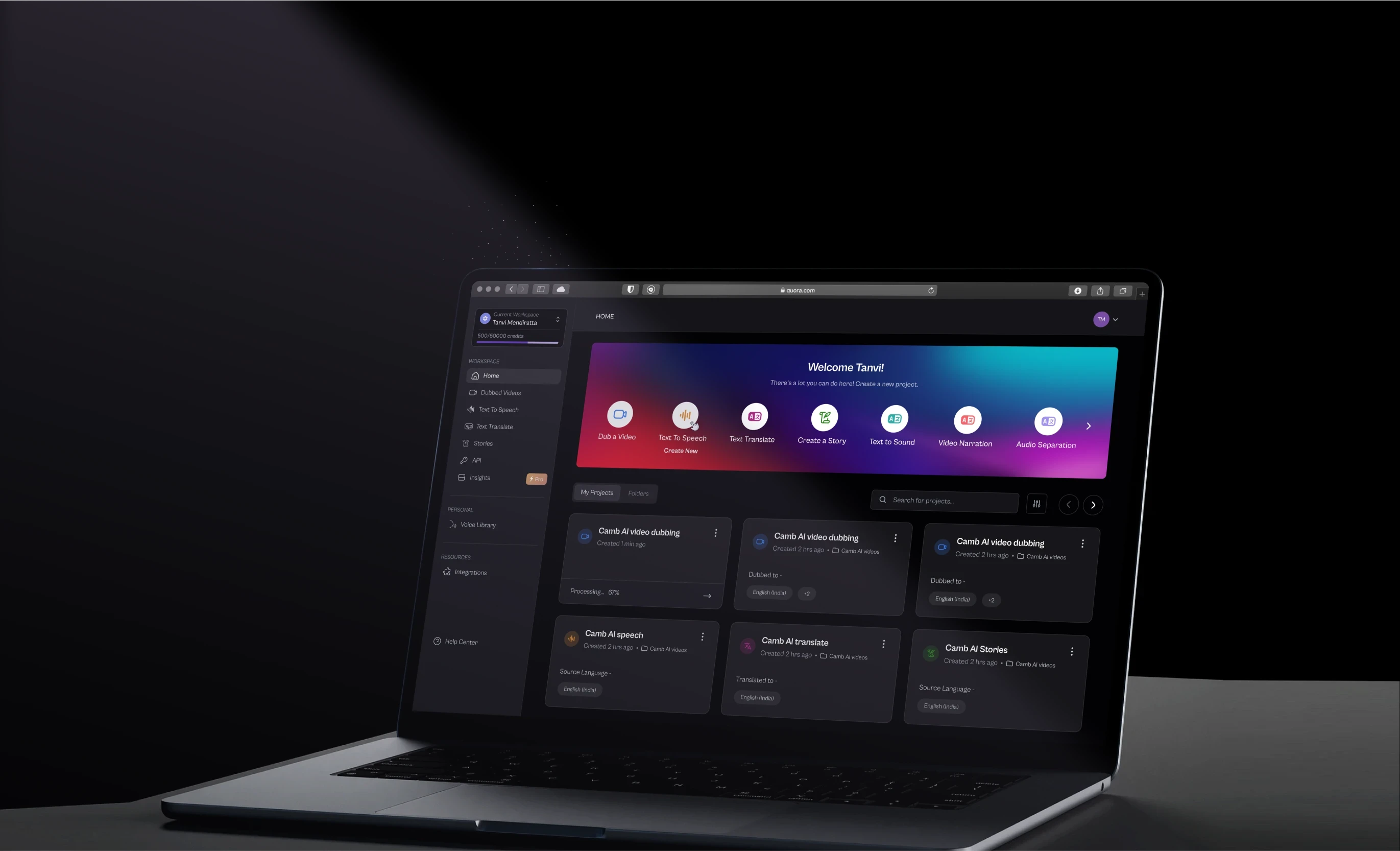
Our rate is the lowest on this page, and it is the only column where we lead. It is also the whole argument, which is why the cost comparison above is laid out honestly rather than framed to flatter us. The clearest example of the work is the Camb.ai dubbing platform, a six-month engagement covering dashboard navigation, the editor and the design system underneath both.

Best for: SaaS and AI product companies where the interface carries a technical story.

Not right for: in-person research with Bay Area users, on-site workshops, or a brief where investor optics genuinely matter. For the first of those, hire Blink UX or Neuron. They do that work properly and we do not. Saying so costs us nothing, because it was never work we would have been right for.

Want to know where your users are dropping off?

We’ll break down the exact moments users lose interest, and why.

Want to know where your users are dropping off?

We’ll break down the exact moments users lose interest, and why.

2. Blink UX

Blink UX homepage describing a product design firm offering UX research and AI workflow transformation, established 2000

Address: 575 Market St., Suite 710, San Francisco, CA 94105. Founded: 2000. Team: 150 to 200. Hourly: not published. Minimum: $25,000+. Rating: 5.0, on a single review.

The most research-weighted firm on this list and the only one whose published service mix leads with market research alongside product design. Named clients include Amazon, JPMorganChase, Qualcomm, Google, Blue Cross Blue Shield and NASA.

Three things to know. San Francisco is a studio, not the headquarters: Blink's own contact page labels Seattle as HQ and calls it the flagship, with six offices in total. The phone number published on the San Francisco page carries a 206 area code, which is Seattle. And its logo now reads "an Mphasis company", so the firm sits inside a listed IT services group, which is worth knowing for the same reason frog's ownership is further down this list.

Blink is also the firm here most likely to sell you research on its own, which is the cheaper way to start if you are not yet sure a redesign is the answer. Our guide to usability testing services sets out what that costs as a standalone purchase.

Best for: research-led work where the evidence has to survive a sceptical stakeholder.

Not right for: a team that wants the principals, which at this size you will not get.

3. Neuron

Neuron homepage describing a San Francisco-based UX/UI design agency for enterprise software, with client logos

Address: 650 California St, Floor 7, San Francisco, CA 94108. Founded: 2016. Team: 10 to 49. Hourly: $150 to $199. Minimum: $25,000+. Rating: 4.9, on 53 reviews.

The strongest local signal of any firm on this page, and it is not an accident that Neuron's own site ranks first for this search. It publishes a full street address, a floor, a local 415 number and a page headed "Contact Neuron's San Francisco HQ". Its published service mix is 100% UX and UI design, which no other firm here matches. Named clients include IKEA, Vendr, Paycom, Flo and Houghton Mifflin Harcourt.

The deepest review record on this list by a distance, 53 against the next highest at 34, which in a market this thin on public evidence counts for a lot.

Best for: complex B2B and enterprise software where the UX problem is the whole problem.

Not right for: branding, marketing sites, or anything where design is one line in a wider build.

4. RNO1

RNO1 homepage positioning the studio as a global branding, UX and digital growth agency

Address: 650 California Street, San Francisco. Founded: 2010. Team: 10 to 49. Hourly: not published. Minimum: $25,000+. Rating: 4.8, on 6 reviews.

Brand and UX together, with named work including Dentsu, Magic Patterns and Interos. The service mix is 40% UX and UI with 30% web design and 20% branding behind it, which makes it a reasonable fit when identity and product are moving at the same time.

The address is worth reading carefully. RNO1 publishes 650 California Street, the same street address as Neuron, one entry above. Neuron gives a floor and calls it a headquarters. RNO1 gives no floor, no ZIP, no building detail, and the page heading over its five locations reads "Meeting Locations" rather than offices. That is their own wording, not our characterisation. It may mean exactly what it says, and it is the kind of detail worth a direct question on the first call.

Best for: brand and product moving together for a growth-stage company.

Not right for: anyone who needs a dedicated local team in a room.

5. Clay

Clay homepage describing a global branding and UX design agency, with client project previews

Address: 300 Broadway, San Francisco, CA 94133. Founded: 2009. Team: 51 to 100 on its directory profile, 78 on its own site. Hourly: $150 to $199. Minimum: $50,000+. Rating: 4.8, on 32 reviews.

The best-known name on this search, and the one four of the eight related searches are about. Clay is a branding and UX agency, remote-first with San Francisco as its stated headquarters and five further offices including New York, Austin, Denver, Lisbon and Belgrade. The client list is the strongest here: Meta, Google, Slack, Snapchat, Coinbase, Stripe, Amazon and Uber among 33 named.

Two small discrepancies worth noting because they come from Clay's own pages. Its about page says "16 Years In Business" while the site footer reads "© 2016–2026", and its directory profile puts the team at 10 to 49 against the 78 global team members Clay publishes itself. Neither is damning. Both are the sort of thing worth asking about if precision matters to you.

Best for: funded companies refreshing brand and product together.

Not right for: a $25,000 budget, which does not clear the minimum.

6. Impekable

Impekable homepage leading with AI-powered operational modernisation rather than UX design services

Address: 2261 Market Street, STE 10822, San Francisco, CA 94114. Founded: 2012. Team: 10 to 49. Hourly: $200 to $300. Minimum: $50,000+. Rating: 4.8, on 32 reviews.

Labelled "San Francisco HQ" on its own site, with a second office in Sydney. Named work includes Adobe, SiriusXM and Zingbox at Palo Alto Networks, and the rate band sits at the top of this market alongside Extractable.

Read the current service mix before you shortlist it as a UX agency. Impekable's directory profile now shows 35% AI development, 20% custom software, 15% AI agents, 15% AI consulting and 15% generative AI. UX and UI design does not appear as a service line at all, and its own site leads with AI voice agents and conversational AI services. This is a firm that has moved from design consultancy to AI engineering, which is a fine thing to be and not what most people typing this search are looking for. The published address also carries a four-digit suite number with no floor or building named.

Best for: teams buying AI implementation with design attached.

Not right for: a pure UX engagement, where the service mix no longer matches the brief.

7. Ramotion

Ramotion homepage describing a product and brand design agency for marketing and product executives

Address: 28 Geary St, Suite 650, San Francisco, CA 94108. Founded: 2009. Team: 10 to 49. Hourly: $150 to $199. Minimum: $50,000+. Rating: 4.9, on 29 reviews.

Branding and UX in near-equal measure, "in the industry since 2009" by its own account, with offices in Los Angeles and New York alongside San Francisco. Named clients include Netflix, Salesforce, Stripe, Adobe, Mozilla and Universal Music, which is the second strongest list here after Clay.

Ramotion is also the only firm on this page that publishes a project range on its own website, $25,000 to over $100,000, which is more transparency than any competitor on this search manages and more than most firms on this list. If you are weighing it against firms in the same band, we have written up the alternatives to Ramotion separately.

Best for: brand-led product work for a funded company, with a real published price range.

Not right for: research-first engagements, which are not what this practice is weighted toward.

8. Extractable

Extractable homepage offering user experience, design and digital strategy for financial services

Address: 400 Concar Drive, San Mateo, CA 94402. Founded: 1999. Team: 10 to 49. Hourly: $200 to $300. Minimum: not published. Rating: 4.5, on 2 reviews.

The Peninsula entry, and the most specialised firm on this list: Extractable states that it consults exclusively with financial services clients, and the named roster bears that out, including Charles Schwab Advisor Services, Patelco Credit Union, Bank of Oklahoma and SF Fire Credit Union.

Two notes. Its own homepage metadata describes the company as "San Francisco based" while the only address it publishes is in San Mateo, about twenty miles south. And the 4.5 rating rests on two reviews, so the twenty-six year history is the stronger signal here.

Best for: banks, credit unions and wealth platforms, where the regulatory context is the hard part.

Not right for: anything outside financial services, by the firm's own description.

9. frog

frog homepage showing its showreel beneath the Part of Capgemini Invent wordmark

Address: 1011 3rd Street, Suite 300, San Francisco, CA 94158. Founded: 1969. Team: 1900. Hourly: $100 to $149 published, see below. Minimum: $5,000 published, see below. Not rated.

frog is one of the oldest names in the industry, now operating as "frog, part of Capgemini Invent", which is the only formulation its own site uses. There is no sentence anywhere on frog.co explaining what that relationship means in practice, and the footer's privacy, terms and cookie links all point to capgemini.com. The San Francisco studio is one of 32 worldwide, with recent published work including Mammoth Biosciences and Aircapture.

Why the published figures are not used for ordering. frog's directory profile shows a $5,000 minimum and a $100 to $149 hourly rate on a profile carrying no reviews. For a firm of more than a thousand people inside a global consultancy, those are not quotes, they are defaults on a page nobody maintains. Treating them as real would put frog at the top of a list ordered by price, which would be the single most misleading thing on this page. The numbers are printed above so you can judge that for yourself, and they are the reason this entry sits with the firms publishing nothing rather than with the cheapest.

Best for: enterprise programmes where a global consultancy relationship is the point.

Not right for: a Series A team, which will not be the account that gets the attention.

10. IDEO

IDEO homepage showing a design workshop in progress with printed strategy posters

Address: 350 Florida St, San Francisco, CA 94110. Founded: 1991. Team: 1320. Hourly: not published. Minimum: not published. Not rated.

Founded in Palo Alto in 1991 by David Kelley, Bill Moggridge and Mike Nuttall, and the firm that did more than any other to put design thinking into the business vocabulary. San Francisco is one of five studios, alongside Cambridge, Chicago, London and Shanghai. Named work includes Apple, Ford and Moderna.

IDEO publishes no rate and no minimum anywhere, and the engagement model is strategic consulting rather than product delivery. It appears on nearly every list for this search, and it is the right answer for a narrower set of briefs than that implies.

Best for: organisational and strategic design work with executive sponsorship.

Not right for: shipping a product feature, which is a different purchase entirely.

11. Punchcut

Punchcut homepage positioning the studio as a design accelerator with human-centred AI expertise

Address: 150 California Street, 9th Floor, San Francisco, CA 94111. Founded: 2002. Team: 51 to 100. Hourly: not published. Minimum: not published. Not rated.

Founded in San Francisco in September 2002 and still operating from one city, which is rare on this list. The practice is interface design for connected products and devices, with published work spanning Android, Amazon Fire TV, Chromecast and Lucid Motors, and named enterprise clients including Salesforce, AWS, Visa and Disney Studios.

One thing to resolve before you call them. Punchcut's site footer publishes 150 California Street, 9th Floor, 94111. Punchcut's own article ranking for this search publishes 550 California Street, Suite 1220, 94104 for itself, in the body of a page whose footer carries the first address. Both are on Punchcut's own domain and they are different buildings. Its contact page publishes no address at all. This is not a reason to rule the firm out, and it is a reasonable first question.

Best for: device, automotive and connected-product interfaces, where few firms have real depth.

Not right for: a standard SaaS web product, which is not where this practice is strongest.

Who We Left Out, and Why

Every list makes cuts and almost none of them say so. These are ours, with the reason in each case.

Firm

Why it is not on the list

AWAKE

Describes itself as "a San Francisco-based creative agency" on its homepage. The only address published anywhere on its site, including on its privacy policy under its legal name, is 1881 Page Mill Road, Palo Alto. It ranks fifth for this search

Exygy

A genuine San Francisco civic-tech firm, B Corp certified since 2010, but it publishes no street address on any page of its own site and its careers page describes "a remote team". It fails the one rule this list has

EchoUser

Founded in San Francisco in 2006 and named on several competing lists, but publishes no address, carries no reviews on its directory profile, and its own contact page is framed around "project history, archive questions, or anything else worth preserving"

Savas Labs

Lists San Francisco among seven locations, but its headquarters is in New York. Its San Francisco address is published under a space name rather than an office of its own

MetaLab, Fantasy, Delve

All three appear on a page-one San Francisco shortlist elsewhere on this search. Their published headquarters are Vancouver, New York and Boston

UX Studio

Headquartered in Budapest. It was on the previous version of this page and should not have been

Work & Co, Designit

Both now sit inside larger groups and neither lists a San Francisco studio

The pattern across most of those is the same: a city in a page title is not an office. It takes about a minute to check, and it is the first thing we would do with any list on this search, including this one.

Worth saying as well that three of those exclusions are good firms in the wrong city rather than bad firms. If a New York studio is genuinely what you are after, our comparison of the best UX design agencies in New York covers that market on the same basis as this one.

Which Bay Area Agencies Have Actually Shipped AI Products

Nobody writing for this keyword separates firms by whether they have put an AI interface in front of real users, and it has become one of the more useful filters.

Firms with published AI product work: Neuron names AI and machine learning platforms among its specialisms. frog publishes Mammoth Biosciences, a biotech AI company, from the San Francisco studio. RNO1 publishes ResiQuant, an AI underwriting product. Impekable has gone furthest, to the point that AI development now dominates its service mix.

Firms where AI appears as positioning rather than shipped work: Savas Labs publishes "AI-powered strategy" and readiness assessments rather than AI product design. Extractable's only AI reference is an insights headline. Several others mention AI in service copy with nothing shipped behind it.

The question worth asking is narrow and hard to answer with marketing copy: what did you design for the moment the model is wrong? AI features add states that conventional interfaces do not have, loading, low confidence, error, undo and escalation, and a team that has only drawn the happy path will not have an answer. If that is the centre of your brief rather than a feature on the edge of it, our roundup of UX agencies specializing in AI covers firms selected on that basis specifically.

Matching an Agency to Your Stage

Seed to Series A. Your constraint is the minimum, not the rate. At $25,000, Blink UX, Neuron and RNO1 are reachable; at $50,000, most of the rest are not. Scope one flow rather than a full product and you will get further with the budget you have.

Series B to growth. This is the band most of this list is built for. Clay and Ramotion both sit at $50,000 with $150 to $199 rates, and both do brand and product together, which is usually the stage when those two stop being separable. Neuron is the alternative if the problem is genuinely the product rather than the positioning, and its $25,000 minimum leaves room to run a scoped piece first and expand if it goes well. If your product is specifically a SaaS platform rather than a consumer app, our shortlist of top UX agencies for SaaS USA is a narrower filter than any city list can be, because the thing that separates firms at this stage is whether they have worked inside a subscription product with roles, permissions and billing states rather than whether they sit in the right postcode.

Enterprise. frog, IDEO and Blink UX are the three here built for programmes with multiple stakeholders and a procurement process. Expect discovery to take longer than you want, expect to spend real time on alignment before anyone draws anything, and budget for both. The failure mode at this size is not quality, it is a project that quietly becomes about managing the engagement rather than shipping the work.

Any stage, if the budget will not stretch. Look outside the city before you compromise on the firm. The instinct when a quote comes back too high is to find a cheaper firm in the same market, and in the Bay Area that usually means a less experienced team at a rate that is still high. Changing the geography is the better lever, because almost nothing about the rate band here is explained by capability. Our comparison of top UX agencies in Los Angeles covers the nearest large market with the same time zone and a materially lower entry point.

When a San Francisco Office Matters, and When It Does Not

This is the question underneath the whole search and nobody on this SERP answers it.

An office matters when the work needs to be in a room. In-person research with Bay Area users, contextual inquiry in someone's workplace, a two-day workshop where the point is the arguing, a stakeholder group that only makes decisions when it is physically together. Those are real, and remote versions of them are worse rather than cheaper.

It matters for optics more often than people admit. If your board or your buyers expect a Bay Area design partner on the credits, that is a real requirement even though no brief ever writes it down.

It does not matter for most async product work. A design system, a SaaS onboarding flow, a dashboard redesign, a component library. These are built in Figma, reviewed in a call and shipped by engineers who are themselves distributed. Paying a Bay Area premium for work that never leaves a browser is a habit rather than a decision.

The in-between option most people skip. The East Bay is a twenty-minute BART ride from the Financial District and a different price market entirely. We have written up the Oakland design studios with their published minimums, and the gap between those and the firms on this page is larger than the distance suggests. It is the option that gets overlooked because "San Francisco" is what people type, not because anyone compared the two and chose. If the real requirement is that someone can be in your office within an hour, the East Bay clears it as easily as the Financial District does, at a minimum that starts lower.

We have set out the full argument, including the two things that make remote engagements fail and how to avoid both, in our comparison of local and remote design agencies. The short version: proximity buys you a specific set of things, and if your brief does not need those things you are paying for them anyway.

California Accessibility Rules Your Agency Should Answer

One competing page mentions accessibility. None covers what to put in a contract, which is the part that matters.

California Civil Code section 51(f) makes any violation of the Americans with Disabilities Act automatically a violation of the Unruh Civil Rights Act. Section 52 then sets statutory damages at no less than $4,000 per violation, a plaintiff does not have to prove they lost money, and prevailing plaintiffs can recover attorney's fees. That last point is what makes these claims economic to bring in volume, and California remains the most active jurisdiction in the country for them.

No California statute names a technical standard for private business websites. In practice courts and plaintiffs treat the Web Content Accessibility Guidelines as the measure, so what you require in a contract is WCAG 2.1 Level AA at minimum and WCAG 2.2 Level AA ideally.

Four things to settle before you sign: which WCAG version and level the work will meet, who performs the testing, whether assistive technology is used or only an automated scanner, and who pays to fix issues found after launch. Not one of the eleven firms above publishes an accessibility standard on its own site, so you will have to ask. An agency that has never been asked will tell you quickly.

Eight Questions for the First Call

Most hiring advice stops at "check the portfolio". These are the eight that actually separate firms on this list, with what a good answer sounds like.

Ask

A good answer

A bad answer

Where is your San Francisco office, and who sits there?

A street address, a floor, and names

A service area, or "we have people in the Bay Area"

Is research in this quote, and what would it cost separately?

Two numbers

One bundled figure and a change of subject

Who specifically is on my project, and for how many hours a week?

Named people, named hours

"A dedicated team"

Show me a component with its full state matrix

Default, hover, focus, disabled, loading, error, empty

A hero shot of a finished screen

What WCAG version and level do you build to, and who tests it?

A version, a level, and a method

"We follow best practices"

What did you design for the moment the AI is wrong?

Low confidence, error, undo, escalation

A demo of the happy path

Show me something you shipped that is still live after a year

A URL, and what changed since

A concept, or a case study with no link

What happens to the work if we stop after discovery?

A clear deliverable you keep

Nothing you can use without phase two

That last one catches more problems than the other seven combined. For the general version of this that applies outside San Francisco and outside product UX, we keep a checklist for hiring a web design agency that covers the commercial terms this table does not.

If your product is AI-led, eight questions will not be enough. The things that disqualify a partner on an AI brief are specific, and almost none of them come up in a normal pitch, because the firm has no reason to raise them and the buyer usually does not know to ask. How a team handles model error, what it does about confidence thresholds, whether anyone has designed a human review step that people actually use, how it treats the data going into the system: these decide whether the work survives contact with a real model, and a portfolio of polished screens tells you nothing about any of them. We have a longer list of questions to ask an AI UX design partner, including the ones that should end the conversation.

Red Flags Before You Sign

An address you cannot find on their own site. Given what this page found in the first five results for this search, this is the first thing to check and the easiest. Ask where they sit. A firm that answers with a service area rather than a street is telling you something.

A suite number with no building, or a page that says "meeting locations". Not disqualifying on its own, and worth one direct question. Two firms on this list warrant it.

A quote before anyone has asked about your content or your research. Both are the longest poles in a design project. A quote that ignores them is a quote that will change.

No answer on accessibility. Given the Unruh exposure above, a firm that cannot name a WCAG level is handing you a liability it will not be paying for.

A portfolio of concepts with nothing shipped. Concept work photographs beautifully and proves nothing about whether a team can get something through engineering, legal and a launch.

A fixed price quoted before discovery. Either they have not understood the scope or they have padded it enough to survive not understanding it. Neither is good for you, and the fix is to read the proposal against what a complete one should contain. We have set that out in what a UX design proposal should include, which doubles as a way to compare two quotes that look nothing like each other.

Conclusion

San Francisco has a real UX design market, and the problem is that you cannot find it easily, because the lists sitting above it are full of firms that are not here.

So start with the address. Then the minimum, because that decides whether a conversation happens at all. Then the service mix, because a firm whose published practice has moved to AI engineering or branding is not what you typed into the search box. Insist on a WCAG answer in writing whichever firm you pick, and ask what happens to the work if you stop after discovery.

And be deliberate about whether you need the Bay Area at all. On published rate bands, the same eight-week engagement costs about $50,000 more here than it does remote. Sometimes that is exactly the right money to spend, for in-person research, for workshops, for the credibility it buys you in a board meeting. Often it is a default nobody examined.

If what you are building is a product where the interface has to carry a technical story, and you want product design, the component system and the marketing site handled by one team rather than three, that is the work we do. The city is the easy part.

Most San Francisco UX lists do not check addresses. One ranking firm publishes a Palo Alto address while calling itself San Francisco based. Another puts its own two addresses on the same page. Every firm below has a published Bay Area address, printed.

Eleven Bay Area firms, real addresses, published rates, costed against remote.

TL;DR

  • Most lists for this search do not check addresses. One firm ranking on page one calls itself San Francisco based on a site whose only published address is in Palo Alto. Another publishes two different addresses for itself on the same page. A third list puts firms headquartered in Vancouver, New York and Boston on a San Francisco shortlist.

  • Published hourly rates in the Bay Area run $100 to $300, and the $150 to $199 band covers most of the market. Nothing with a verified local address publishes below $100.

  • The minimum is what actually gates the conversation, and it ranges from $25,000 to $50,000 across firms that publish one. Three of the eleven publish nothing at all.

  • Eleven firms below have a published Bay Area street address. Four well-known names were cut for failing that test, and we name them and the reason.

  • The same eight-week engagement costs roughly $72,000 to $95,500 at Bay Area rates and $24,000 to $47,500 remote, on published rate bands. Whether that gap is worth paying is a real question, and it is answered further down rather than assumed.

Search for a UX design agency in San Francisco and the first two results are agencies rather than articles. The lists in between have a different problem.

One of them puts ten firms on a San Francisco shortlist without printing a single address, and three of those firms are headquartered in Vancouver, New York and Boston. The firm sitting fifth on this search describes itself as "a San Francisco-based creative agency" on a site whose only published address, including on its own legal privacy page, is on Page Mill Road in Palo Alto. And one agency's own article about the best San Francisco agencies gives itself an address that the footer of that very page contradicts.

None of that is hard to check. It takes about a minute per firm, and nobody ranking for this search has done it.

So this page has one rule. Every firm below publishes a Bay Area street address on its own website, and that address is printed in its entry. Where the address is thin, a suite number with no building, or a page that calls its locations "meeting locations" rather than offices, that is said plainly too, because it tells you something.

Groto is our own studio. We are not a San Francisco company, we are a remote team, and we have said so in our entry rather than describing ourselves as serving the Bay Area. The list is ordered by published project minimum, lowest first, so position reflects a published number and nothing else. No firm paid for placement.

Quick Comparison: San Francisco and Bay Area UX Design Agencies

#

Agency

Published address

City

Founded

Team

Hourly

Minimum

Rating

1

Groto

Remote

Remote

2021

10-49

$50 to $99

$5,000+

4.9

2

Blink UX

575 Market St., Suite 710

San Francisco

2000

150-200

Not published

$25,000+

5.0

3

Neuron

650 California St, Floor 7

San Francisco

2016

10-49

$150 to $199

$25,000+

4.9

4

RNO1

650 California Street

San Francisco

2010

10-49

Not published

$25,000+

4.8

5

Clay

300 Broadway

San Francisco

2009

51-100

$150 to $199

$50,000+

4.8

6

Impekable

2261 Market Street, STE 10822

San Francisco

2012

10-49

$200 to $300

$50,000+

4.8

7

Ramotion

28 Geary St, Suite 650

San Francisco

2009

10-49

$150 to $199

$50,000+

4.9

8

Extractable

400 Concar Drive

San Mateo

1999

10-49

$200 to $300

None published

4.5

9

frog

1011 3rd Street, Suite 300

San Francisco

1969

1900

$100 to $149

See entry

Not rated

10

IDEO

350 Florida St

San Francisco

1991

1320

Not published

None published

Not rated

11

Punchcut

150 California Street, 9th Floor

San Francisco

2002

51-100

Not published

None published

Not rated

Three things to read off this before the entries.

The order is not a quality ranking. It is published minimum, lowest first, with ties breaking alphabetically, and the four firms that publish no usable minimum sitting at the end. frog is the one judgement call in that rule, and since the call happens to benefit us, here is the full reasoning. Its directory profile shows a $5,000 minimum and a $100 to $149 hourly rate, on a profile carrying no reviews. Neither figure is a plausible quote from a firm of more than a thousand people inside Capgemini Invent; they read as defaults on a page nobody maintains. We have grouped it with the firms publishing nothing rather than treating a default as a price. The underlying figure is in its entry, unedited, so you can disagree with us.

The ratings do not separate these firms. Everything rated sits between 4.5 and 5.0, three firms have no rating at all, and two of the rated ones rest on fewer than seven reviews. Portfolios and reference calls will tell you more here than a star average.

The minimum is the column that matters. It is the number that decides whether a conversation happens at all, and the spread across these eleven is large, checkable and consequential in a way nothing else on this table is.

How We Picked These Agencies

A published Bay Area street address on the firm's own site. This rule did most of the work and it removed more well-known names than anything else. A city in a page title is not an address. A service area is not an address. Where a firm publishes an address but labels it something other than an office, that is noted in its entry rather than hidden.

UX or product design as a core practice, not an attachment. Two firms with genuine Bay Area addresses were dropped on this rule, and one firm on the list is flagged inside its entry because its published service mix has moved away from design. If your search is for a UX agency, a branding studio with a UX page is a different purchase.

Numbers that actually exist. Rates, minimums, team sizes and founding years are in the table where firms or their directory profiles publish them. Where nothing is published, the table says so, because a firm that will not name a number before a call is telling you something about how it sells.

Ordered by published minimum, lowest first. Ties break alphabetically. Firms publishing no minimum sit at the end. We did not adjust the order to flatter anyone, including ourselves.

One disclosure. Groto wrote this list. We are a remote studio with no Bay Area office, which is why our entry says "Remote" rather than claiming to serve San Francisco. If you want the broader national picture rather than one city, our comparison of the best UX design agencies in the US covers the market as a whole.

What a UX Design Agency in San Francisco Costs in 2026

Price by scope

What you are buying

Typical Bay Area cost

Rough timeline

Research only, no design

$20,000 to $40,000

3 to 6 weeks

A single flow redesigned

$25,000 to $50,000

4 to 8 weeks

A full product design engagement

$50,000 to $150,000

3 to 6 months

Design plus build

$150,000+

4 months and up

A monthly design subscription

Billed per month, no project minimum

Ongoing, cancel or pause

That last row is the one buyers in this market tend not to know exists. Instead of scoping a project, you hire capacity by the month and queue work against it, which suits a team with a steady flow of small briefs rather than one large redesign. It is a genuinely different purchase with different failure modes, and we have compared the providers in our guide to the best design subscription agency options for SaaS.

The most useful figure here does not come from a roundup. Ramotion publishes its own range on its own San Francisco page: $25,000 to over $100,000 for a standard engagement. That is a first-party number from a firm on this list, and it brackets the middle two rows above almost exactly.

What Bay Area firms actually publish, and what they do not

Published hourly rates across this list run $100 to $149 at the low end and $200 to $300 at the top, with $150 to $199 covering Clay, Neuron and Ramotion. Nothing with a verified Bay Area address publishes below $100 an hour.

Published minimums are $25,000 at Blink UX, Neuron and RNO1 and $50,000 at Clay, Impekable and Ramotion. Extractable, IDEO and Punchcut publish no minimum anywhere.

Five of the eleven publish no hourly rate at all. None of the eleven publishes a price on its own website. Every figure in the table above comes from a directory profile rather than from the firm's own pages, which is worth knowing before you treat any of it as a quote. If you want the mechanics of how agencies actually structure fees rather than the numbers alone, we have web design agency fee structures explained in detail.

Why two quotes for the same product differ by three times

Who does the work. A ten-person studio and a thousand-person consultancy bill differently for the same screen, and neither is wrong.

Whether research is in scope. This is the single largest swing, and it is covered below, because most buyers do not realise research is a separate purchase.

Whether engineering is included. Design plus build is a different product from design alone. Four firms on this list sell both. Most sell one. And if your product has a physical component, you are shopping in a different category again, where the leading product design studios in San Francisco include firms that design objects rather than interfaces.

Seniority mix. A $200 to $300 band usually means principals on the work. A $150 to $199 band usually means a team with a lead. Ask who specifically is on your project and for how many hours a week, and the rate starts to explain itself.

Research is a separate purchase, and most buyers do not know it

You can buy user research without buying design. Discovery interviews, usability testing, a competitive teardown and a synthesis readout are a complete engagement on their own, and for a team that already has designers, it is frequently the only thing worth buying from outside.

It matters here because it changes the quote by tens of thousands. A proposal that bundles research into a design engagement is not wrong, but it makes the two impossible to compare across firms. Ask for them priced separately and the shortlist suddenly becomes comparable.

If research is the only thing you actually need, the firms that specialise in it are a different roster from the one below, and our ranking of user research firms compares them on method, recruiting speed and timeline rather than on design output.

The same project, both ways

Nobody on this search prices the same scope locally and remotely, so here it is.

Take an eight-week SaaS onboarding redesign, two designers, roughly 30 hours a week each. That is about 480 hours.


Hourly band

480 hours

Minimum gate

Bay Area firm at the common band

$150 to $199

$72,000 to $95,520

$25,000 to $50,000

Bay Area firm at the top band

$200 to $300

$96,000 to $144,000

$50,000

Remote studio at Groto's published rates

$50 to $99

$24,000 to $47,520

$5,000

The honest reading of that table is not that remote wins. It is that the gap is roughly $50,000 on a single eight-week project, and that is a large enough number to be worth a deliberate decision rather than a default. What the Bay Area premium buys is covered below, and sometimes it is worth every dollar.

That bottom row is also the widest band in the whole market, and it is the one where quality varies most. If you are going to price the offshore option seriously rather than use it as a negotiating position, our comparison of UI UX design agencies in India sets out what separates the firms at that end on cost, city and fit.

The 11 Agencies

1. Groto

Groto homepage showing its AI-first UX design agency positioning and 4.9 Clutch rating

Address: remote, working across US time zones. Founded: 2021. Team: 10 to 49. Hourly: $50 to $99. Minimum: $5,000+. Rating: 4.9.

We are not a Bay Area company. We are on this page as the remote option, and we sit first because the list is ordered by published minimum and ours is the lowest here, not because we are the right answer for a San Francisco buyer.

The narrow case where remote beats local: you are a SaaS or AI company whose product and marketing site have to tell the same story, you would rather not split product design and web across two vendors, and nothing about the work requires sitting in a room with Bay Area users. That is what we build.

Our rate is the lowest on this page, and it is the only column where we lead. It is also the whole argument, which is why the cost comparison above is laid out honestly rather than framed to flatter us. The clearest example of the work is the Camb.ai dubbing platform, a six-month engagement covering dashboard navigation, the editor and the design system underneath both.

Best for: SaaS and AI product companies where the interface carries a technical story.

Not right for: in-person research with Bay Area users, on-site workshops, or a brief where investor optics genuinely matter. For the first of those, hire Blink UX or Neuron. They do that work properly and we do not. Saying so costs us nothing, because it was never work we would have been right for.

Want to know where your users are dropping off?

We’ll break down the exact moments users lose interest, and why.

2. Blink UX

Blink UX homepage describing a product design firm offering UX research and AI workflow transformation, established 2000

Address: 575 Market St., Suite 710, San Francisco, CA 94105. Founded: 2000. Team: 150 to 200. Hourly: not published. Minimum: $25,000+. Rating: 5.0, on a single review.

The most research-weighted firm on this list and the only one whose published service mix leads with market research alongside product design. Named clients include Amazon, JPMorganChase, Qualcomm, Google, Blue Cross Blue Shield and NASA.

Three things to know. San Francisco is a studio, not the headquarters: Blink's own contact page labels Seattle as HQ and calls it the flagship, with six offices in total. The phone number published on the San Francisco page carries a 206 area code, which is Seattle. And its logo now reads "an Mphasis company", so the firm sits inside a listed IT services group, which is worth knowing for the same reason frog's ownership is further down this list.

Blink is also the firm here most likely to sell you research on its own, which is the cheaper way to start if you are not yet sure a redesign is the answer. Our guide to usability testing services sets out what that costs as a standalone purchase.

Best for: research-led work where the evidence has to survive a sceptical stakeholder.

Not right for: a team that wants the principals, which at this size you will not get.

3. Neuron

Neuron homepage describing a San Francisco-based UX/UI design agency for enterprise software, with client logos

Address: 650 California St, Floor 7, San Francisco, CA 94108. Founded: 2016. Team: 10 to 49. Hourly: $150 to $199. Minimum: $25,000+. Rating: 4.9, on 53 reviews.

The strongest local signal of any firm on this page, and it is not an accident that Neuron's own site ranks first for this search. It publishes a full street address, a floor, a local 415 number and a page headed "Contact Neuron's San Francisco HQ". Its published service mix is 100% UX and UI design, which no other firm here matches. Named clients include IKEA, Vendr, Paycom, Flo and Houghton Mifflin Harcourt.

The deepest review record on this list by a distance, 53 against the next highest at 34, which in a market this thin on public evidence counts for a lot.

Best for: complex B2B and enterprise software where the UX problem is the whole problem.

Not right for: branding, marketing sites, or anything where design is one line in a wider build.

4. RNO1

RNO1 homepage positioning the studio as a global branding, UX and digital growth agency

Address: 650 California Street, San Francisco. Founded: 2010. Team: 10 to 49. Hourly: not published. Minimum: $25,000+. Rating: 4.8, on 6 reviews.

Brand and UX together, with named work including Dentsu, Magic Patterns and Interos. The service mix is 40% UX and UI with 30% web design and 20% branding behind it, which makes it a reasonable fit when identity and product are moving at the same time.

The address is worth reading carefully. RNO1 publishes 650 California Street, the same street address as Neuron, one entry above. Neuron gives a floor and calls it a headquarters. RNO1 gives no floor, no ZIP, no building detail, and the page heading over its five locations reads "Meeting Locations" rather than offices. That is their own wording, not our characterisation. It may mean exactly what it says, and it is the kind of detail worth a direct question on the first call.

Best for: brand and product moving together for a growth-stage company.

Not right for: anyone who needs a dedicated local team in a room.

5. Clay

Clay homepage describing a global branding and UX design agency, with client project previews

Address: 300 Broadway, San Francisco, CA 94133. Founded: 2009. Team: 51 to 100 on its directory profile, 78 on its own site. Hourly: $150 to $199. Minimum: $50,000+. Rating: 4.8, on 32 reviews.

The best-known name on this search, and the one four of the eight related searches are about. Clay is a branding and UX agency, remote-first with San Francisco as its stated headquarters and five further offices including New York, Austin, Denver, Lisbon and Belgrade. The client list is the strongest here: Meta, Google, Slack, Snapchat, Coinbase, Stripe, Amazon and Uber among 33 named.

Two small discrepancies worth noting because they come from Clay's own pages. Its about page says "16 Years In Business" while the site footer reads "© 2016–2026", and its directory profile puts the team at 10 to 49 against the 78 global team members Clay publishes itself. Neither is damning. Both are the sort of thing worth asking about if precision matters to you.

Best for: funded companies refreshing brand and product together.

Not right for: a $25,000 budget, which does not clear the minimum.

6. Impekable

Impekable homepage leading with AI-powered operational modernisation rather than UX design services

Address: 2261 Market Street, STE 10822, San Francisco, CA 94114. Founded: 2012. Team: 10 to 49. Hourly: $200 to $300. Minimum: $50,000+. Rating: 4.8, on 32 reviews.

Labelled "San Francisco HQ" on its own site, with a second office in Sydney. Named work includes Adobe, SiriusXM and Zingbox at Palo Alto Networks, and the rate band sits at the top of this market alongside Extractable.

Read the current service mix before you shortlist it as a UX agency. Impekable's directory profile now shows 35% AI development, 20% custom software, 15% AI agents, 15% AI consulting and 15% generative AI. UX and UI design does not appear as a service line at all, and its own site leads with AI voice agents and conversational AI services. This is a firm that has moved from design consultancy to AI engineering, which is a fine thing to be and not what most people typing this search are looking for. The published address also carries a four-digit suite number with no floor or building named.

Best for: teams buying AI implementation with design attached.

Not right for: a pure UX engagement, where the service mix no longer matches the brief.

7. Ramotion

Ramotion homepage describing a product and brand design agency for marketing and product executives

Address: 28 Geary St, Suite 650, San Francisco, CA 94108. Founded: 2009. Team: 10 to 49. Hourly: $150 to $199. Minimum: $50,000+. Rating: 4.9, on 29 reviews.

Branding and UX in near-equal measure, "in the industry since 2009" by its own account, with offices in Los Angeles and New York alongside San Francisco. Named clients include Netflix, Salesforce, Stripe, Adobe, Mozilla and Universal Music, which is the second strongest list here after Clay.

Ramotion is also the only firm on this page that publishes a project range on its own website, $25,000 to over $100,000, which is more transparency than any competitor on this search manages and more than most firms on this list. If you are weighing it against firms in the same band, we have written up the alternatives to Ramotion separately.

Best for: brand-led product work for a funded company, with a real published price range.

Not right for: research-first engagements, which are not what this practice is weighted toward.

8. Extractable

Extractable homepage offering user experience, design and digital strategy for financial services

Address: 400 Concar Drive, San Mateo, CA 94402. Founded: 1999. Team: 10 to 49. Hourly: $200 to $300. Minimum: not published. Rating: 4.5, on 2 reviews.

The Peninsula entry, and the most specialised firm on this list: Extractable states that it consults exclusively with financial services clients, and the named roster bears that out, including Charles Schwab Advisor Services, Patelco Credit Union, Bank of Oklahoma and SF Fire Credit Union.

Two notes. Its own homepage metadata describes the company as "San Francisco based" while the only address it publishes is in San Mateo, about twenty miles south. And the 4.5 rating rests on two reviews, so the twenty-six year history is the stronger signal here.

Best for: banks, credit unions and wealth platforms, where the regulatory context is the hard part.

Not right for: anything outside financial services, by the firm's own description.

9. frog

frog homepage showing its showreel beneath the Part of Capgemini Invent wordmark

Address: 1011 3rd Street, Suite 300, San Francisco, CA 94158. Founded: 1969. Team: 1900. Hourly: $100 to $149 published, see below. Minimum: $5,000 published, see below. Not rated.

frog is one of the oldest names in the industry, now operating as "frog, part of Capgemini Invent", which is the only formulation its own site uses. There is no sentence anywhere on frog.co explaining what that relationship means in practice, and the footer's privacy, terms and cookie links all point to capgemini.com. The San Francisco studio is one of 32 worldwide, with recent published work including Mammoth Biosciences and Aircapture.

Why the published figures are not used for ordering. frog's directory profile shows a $5,000 minimum and a $100 to $149 hourly rate on a profile carrying no reviews. For a firm of more than a thousand people inside a global consultancy, those are not quotes, they are defaults on a page nobody maintains. Treating them as real would put frog at the top of a list ordered by price, which would be the single most misleading thing on this page. The numbers are printed above so you can judge that for yourself, and they are the reason this entry sits with the firms publishing nothing rather than with the cheapest.

Best for: enterprise programmes where a global consultancy relationship is the point.

Not right for: a Series A team, which will not be the account that gets the attention.

10. IDEO

IDEO homepage showing a design workshop in progress with printed strategy posters

Address: 350 Florida St, San Francisco, CA 94110. Founded: 1991. Team: 1320. Hourly: not published. Minimum: not published. Not rated.

Founded in Palo Alto in 1991 by David Kelley, Bill Moggridge and Mike Nuttall, and the firm that did more than any other to put design thinking into the business vocabulary. San Francisco is one of five studios, alongside Cambridge, Chicago, London and Shanghai. Named work includes Apple, Ford and Moderna.

IDEO publishes no rate and no minimum anywhere, and the engagement model is strategic consulting rather than product delivery. It appears on nearly every list for this search, and it is the right answer for a narrower set of briefs than that implies.

Best for: organisational and strategic design work with executive sponsorship.

Not right for: shipping a product feature, which is a different purchase entirely.

11. Punchcut

Punchcut homepage positioning the studio as a design accelerator with human-centred AI expertise

Address: 150 California Street, 9th Floor, San Francisco, CA 94111. Founded: 2002. Team: 51 to 100. Hourly: not published. Minimum: not published. Not rated.

Founded in San Francisco in September 2002 and still operating from one city, which is rare on this list. The practice is interface design for connected products and devices, with published work spanning Android, Amazon Fire TV, Chromecast and Lucid Motors, and named enterprise clients including Salesforce, AWS, Visa and Disney Studios.

One thing to resolve before you call them. Punchcut's site footer publishes 150 California Street, 9th Floor, 94111. Punchcut's own article ranking for this search publishes 550 California Street, Suite 1220, 94104 for itself, in the body of a page whose footer carries the first address. Both are on Punchcut's own domain and they are different buildings. Its contact page publishes no address at all. This is not a reason to rule the firm out, and it is a reasonable first question.

Best for: device, automotive and connected-product interfaces, where few firms have real depth.

Not right for: a standard SaaS web product, which is not where this practice is strongest.

Who We Left Out, and Why

Every list makes cuts and almost none of them say so. These are ours, with the reason in each case.

Firm

Why it is not on the list

AWAKE

Describes itself as "a San Francisco-based creative agency" on its homepage. The only address published anywhere on its site, including on its privacy policy under its legal name, is 1881 Page Mill Road, Palo Alto. It ranks fifth for this search

Exygy

A genuine San Francisco civic-tech firm, B Corp certified since 2010, but it publishes no street address on any page of its own site and its careers page describes "a remote team". It fails the one rule this list has

EchoUser

Founded in San Francisco in 2006 and named on several competing lists, but publishes no address, carries no reviews on its directory profile, and its own contact page is framed around "project history, archive questions, or anything else worth preserving"

Savas Labs

Lists San Francisco among seven locations, but its headquarters is in New York. Its San Francisco address is published under a space name rather than an office of its own

MetaLab, Fantasy, Delve

All three appear on a page-one San Francisco shortlist elsewhere on this search. Their published headquarters are Vancouver, New York and Boston

UX Studio

Headquartered in Budapest. It was on the previous version of this page and should not have been

Work & Co, Designit

Both now sit inside larger groups and neither lists a San Francisco studio

The pattern across most of those is the same: a city in a page title is not an office. It takes about a minute to check, and it is the first thing we would do with any list on this search, including this one.

Worth saying as well that three of those exclusions are good firms in the wrong city rather than bad firms. If a New York studio is genuinely what you are after, our comparison of the best UX design agencies in New York covers that market on the same basis as this one.

Which Bay Area Agencies Have Actually Shipped AI Products

Nobody writing for this keyword separates firms by whether they have put an AI interface in front of real users, and it has become one of the more useful filters.

Firms with published AI product work: Neuron names AI and machine learning platforms among its specialisms. frog publishes Mammoth Biosciences, a biotech AI company, from the San Francisco studio. RNO1 publishes ResiQuant, an AI underwriting product. Impekable has gone furthest, to the point that AI development now dominates its service mix.

Firms where AI appears as positioning rather than shipped work: Savas Labs publishes "AI-powered strategy" and readiness assessments rather than AI product design. Extractable's only AI reference is an insights headline. Several others mention AI in service copy with nothing shipped behind it.

The question worth asking is narrow and hard to answer with marketing copy: what did you design for the moment the model is wrong? AI features add states that conventional interfaces do not have, loading, low confidence, error, undo and escalation, and a team that has only drawn the happy path will not have an answer. If that is the centre of your brief rather than a feature on the edge of it, our roundup of UX agencies specializing in AI covers firms selected on that basis specifically.

Matching an Agency to Your Stage

Seed to Series A. Your constraint is the minimum, not the rate. At $25,000, Blink UX, Neuron and RNO1 are reachable; at $50,000, most of the rest are not. Scope one flow rather than a full product and you will get further with the budget you have.

Series B to growth. This is the band most of this list is built for. Clay and Ramotion both sit at $50,000 with $150 to $199 rates, and both do brand and product together, which is usually the stage when those two stop being separable. Neuron is the alternative if the problem is genuinely the product rather than the positioning, and its $25,000 minimum leaves room to run a scoped piece first and expand if it goes well. If your product is specifically a SaaS platform rather than a consumer app, our shortlist of top UX agencies for SaaS USA is a narrower filter than any city list can be, because the thing that separates firms at this stage is whether they have worked inside a subscription product with roles, permissions and billing states rather than whether they sit in the right postcode.

Enterprise. frog, IDEO and Blink UX are the three here built for programmes with multiple stakeholders and a procurement process. Expect discovery to take longer than you want, expect to spend real time on alignment before anyone draws anything, and budget for both. The failure mode at this size is not quality, it is a project that quietly becomes about managing the engagement rather than shipping the work.

Any stage, if the budget will not stretch. Look outside the city before you compromise on the firm. The instinct when a quote comes back too high is to find a cheaper firm in the same market, and in the Bay Area that usually means a less experienced team at a rate that is still high. Changing the geography is the better lever, because almost nothing about the rate band here is explained by capability. Our comparison of top UX agencies in Los Angeles covers the nearest large market with the same time zone and a materially lower entry point.

When a San Francisco Office Matters, and When It Does Not

This is the question underneath the whole search and nobody on this SERP answers it.

An office matters when the work needs to be in a room. In-person research with Bay Area users, contextual inquiry in someone's workplace, a two-day workshop where the point is the arguing, a stakeholder group that only makes decisions when it is physically together. Those are real, and remote versions of them are worse rather than cheaper.

It matters for optics more often than people admit. If your board or your buyers expect a Bay Area design partner on the credits, that is a real requirement even though no brief ever writes it down.

It does not matter for most async product work. A design system, a SaaS onboarding flow, a dashboard redesign, a component library. These are built in Figma, reviewed in a call and shipped by engineers who are themselves distributed. Paying a Bay Area premium for work that never leaves a browser is a habit rather than a decision.

The in-between option most people skip. The East Bay is a twenty-minute BART ride from the Financial District and a different price market entirely. We have written up the Oakland design studios with their published minimums, and the gap between those and the firms on this page is larger than the distance suggests. It is the option that gets overlooked because "San Francisco" is what people type, not because anyone compared the two and chose. If the real requirement is that someone can be in your office within an hour, the East Bay clears it as easily as the Financial District does, at a minimum that starts lower.

We have set out the full argument, including the two things that make remote engagements fail and how to avoid both, in our comparison of local and remote design agencies. The short version: proximity buys you a specific set of things, and if your brief does not need those things you are paying for them anyway.

California Accessibility Rules Your Agency Should Answer

One competing page mentions accessibility. None covers what to put in a contract, which is the part that matters.

California Civil Code section 51(f) makes any violation of the Americans with Disabilities Act automatically a violation of the Unruh Civil Rights Act. Section 52 then sets statutory damages at no less than $4,000 per violation, a plaintiff does not have to prove they lost money, and prevailing plaintiffs can recover attorney's fees. That last point is what makes these claims economic to bring in volume, and California remains the most active jurisdiction in the country for them.

No California statute names a technical standard for private business websites. In practice courts and plaintiffs treat the Web Content Accessibility Guidelines as the measure, so what you require in a contract is WCAG 2.1 Level AA at minimum and WCAG 2.2 Level AA ideally.

Four things to settle before you sign: which WCAG version and level the work will meet, who performs the testing, whether assistive technology is used or only an automated scanner, and who pays to fix issues found after launch. Not one of the eleven firms above publishes an accessibility standard on its own site, so you will have to ask. An agency that has never been asked will tell you quickly.

Eight Questions for the First Call

Most hiring advice stops at "check the portfolio". These are the eight that actually separate firms on this list, with what a good answer sounds like.

Ask

A good answer

A bad answer

Where is your San Francisco office, and who sits there?

A street address, a floor, and names

A service area, or "we have people in the Bay Area"

Is research in this quote, and what would it cost separately?

Two numbers

One bundled figure and a change of subject

Who specifically is on my project, and for how many hours a week?

Named people, named hours

"A dedicated team"

Show me a component with its full state matrix

Default, hover, focus, disabled, loading, error, empty

A hero shot of a finished screen

What WCAG version and level do you build to, and who tests it?

A version, a level, and a method

"We follow best practices"

What did you design for the moment the AI is wrong?

Low confidence, error, undo, escalation

A demo of the happy path

Show me something you shipped that is still live after a year

A URL, and what changed since

A concept, or a case study with no link

What happens to the work if we stop after discovery?

A clear deliverable you keep

Nothing you can use without phase two

That last one catches more problems than the other seven combined. For the general version of this that applies outside San Francisco and outside product UX, we keep a checklist for hiring a web design agency that covers the commercial terms this table does not.

If your product is AI-led, eight questions will not be enough. The things that disqualify a partner on an AI brief are specific, and almost none of them come up in a normal pitch, because the firm has no reason to raise them and the buyer usually does not know to ask. How a team handles model error, what it does about confidence thresholds, whether anyone has designed a human review step that people actually use, how it treats the data going into the system: these decide whether the work survives contact with a real model, and a portfolio of polished screens tells you nothing about any of them. We have a longer list of questions to ask an AI UX design partner, including the ones that should end the conversation.

Red Flags Before You Sign

An address you cannot find on their own site. Given what this page found in the first five results for this search, this is the first thing to check and the easiest. Ask where they sit. A firm that answers with a service area rather than a street is telling you something.

A suite number with no building, or a page that says "meeting locations". Not disqualifying on its own, and worth one direct question. Two firms on this list warrant it.

A quote before anyone has asked about your content or your research. Both are the longest poles in a design project. A quote that ignores them is a quote that will change.

No answer on accessibility. Given the Unruh exposure above, a firm that cannot name a WCAG level is handing you a liability it will not be paying for.

A portfolio of concepts with nothing shipped. Concept work photographs beautifully and proves nothing about whether a team can get something through engineering, legal and a launch.

A fixed price quoted before discovery. Either they have not understood the scope or they have padded it enough to survive not understanding it. Neither is good for you, and the fix is to read the proposal against what a complete one should contain. We have set that out in what a UX design proposal should include, which doubles as a way to compare two quotes that look nothing like each other.

Conclusion

San Francisco has a real UX design market, and the problem is that you cannot find it easily, because the lists sitting above it are full of firms that are not here.

So start with the address. Then the minimum, because that decides whether a conversation happens at all. Then the service mix, because a firm whose published practice has moved to AI engineering or branding is not what you typed into the search box. Insist on a WCAG answer in writing whichever firm you pick, and ask what happens to the work if you stop after discovery.

And be deliberate about whether you need the Bay Area at all. On published rate bands, the same eight-week engagement costs about $50,000 more here than it does remote. Sometimes that is exactly the right money to spend, for in-person research, for workshops, for the credibility it buys you in a board meeting. Often it is a default nobody examined.

If what you are building is a product where the interface has to carry a technical story, and you want product design, the component system and the marketing site handled by one team rather than three, that is the work we do. The city is the easy part.

Have a project in mind?

Let’s talk through your idea and see what makes sense.

Harpreet Singh

Founder at Groto

Have a project in mind?

Let’s talk through your idea and see what makes sense.

Harpreet Singh

Founder at Groto

FAQ

Everything you were going to ask (and a few things you didn’t know to)

How much does a UX design agency cost in San Francisco?

Published hourly rates across Bay Area firms run $100 to $300, with $150 to $199 covering most of the market and $200 to $300 at the top. Project minimums are $25,000 at the lower end and $50,000 at most established firms, and several publish none at all. For scope, a single flow redesigned typically runs $25,000 to $50,000, a full product engagement $50,000 to $150,000, and design plus build upward of $150,000. Ramotion publishes $25,000 to over $100,000 for a standard engagement on its own site, which is the only first-party figure any firm on this list makes public.

Which is the best UX design agency in San Francisco?

There is no single answer, and the useful question is best for what. On published data, the deepest review record belongs to a Financial District firm with 53 reviews and a service mix that is entirely UX and UI. The most research-weighted practice is a Seattle firm with a Market Street studio. The strongest client list belongs to a Broadway firm with a $50,000 minimum. The only firm publishing its own price range sits on Geary Street. Decide your budget and your category first, then compare two or three names inside it.

Are the agencies on San Francisco lists actually based in San Francisco?

Frequently not. On the page-one results for this search, one list places firms headquartered in Vancouver, New York and Boston on a San Francisco shortlist without publishing an address for any of them, and one firm ranking in the top five describes itself as San Francisco based while publishing a Palo Alto address on its own site. Checking takes about a minute per firm: open their contact page and look for a street address rather than a city name.

Should I hire a San Francisco agency or a remote studio?

It depends on whether the work needs to happen in a room. In-person research with Bay Area users, on-site workshops and stakeholder groups that only decide when they are together are genuine reasons to hire locally. Async product work, design systems, SaaS flows and dashboards are not, and on published rate bands the same eight-week engagement costs roughly $72,000 to $95,500 locally against $24,000 to $47,500 remote. The Peninsula, the East Bay and nearshore markets sit between the two.

What is the difference between a UX design agency and a product design agency?

In practice the labels overlap, but the briefs differ. A UX agency is usually bought for research, flows, interface design and usability, and the deliverable is a designed experience. A product design agency more often covers the whole product definition, sometimes including industrial and hardware design, and the firms that rank for that term include studios that design physical objects. If your product has a physical component, you are shopping in the second category rather than this one.

Does my website need to meet accessibility rules in California?

If you serve the public, in practical terms yes. California Civil Code section 51(f) makes an ADA violation automatically a violation of the Unruh Civil Rights Act, and section 52 sets statutory damages at no less than $4,000 per violation, with attorney's fees recoverable and no requirement to prove financial loss. No California statute specifies a technical standard for private websites, so WCAG 2.1 Level AA is the working minimum and WCAG 2.2 Level AA is the safer target. Put the version, the level, the testing method and who pays for post-launch fixes in the contract.

How much does a UX design agency cost in San Francisco?

Published hourly rates across Bay Area firms run $100 to $300, with $150 to $199 covering most of the market and $200 to $300 at the top. Project minimums are $25,000 at the lower end and $50,000 at most established firms, and several publish none at all. For scope, a single flow redesigned typically runs $25,000 to $50,000, a full product engagement $50,000 to $150,000, and design plus build upward of $150,000. Ramotion publishes $25,000 to over $100,000 for a standard engagement on its own site, which is the only first-party figure any firm on this list makes public.

Which is the best UX design agency in San Francisco?

There is no single answer, and the useful question is best for what. On published data, the deepest review record belongs to a Financial District firm with 53 reviews and a service mix that is entirely UX and UI. The most research-weighted practice is a Seattle firm with a Market Street studio. The strongest client list belongs to a Broadway firm with a $50,000 minimum. The only firm publishing its own price range sits on Geary Street. Decide your budget and your category first, then compare two or three names inside it.

Are the agencies on San Francisco lists actually based in San Francisco?

Frequently not. On the page-one results for this search, one list places firms headquartered in Vancouver, New York and Boston on a San Francisco shortlist without publishing an address for any of them, and one firm ranking in the top five describes itself as San Francisco based while publishing a Palo Alto address on its own site. Checking takes about a minute per firm: open their contact page and look for a street address rather than a city name.

Should I hire a San Francisco agency or a remote studio?

It depends on whether the work needs to happen in a room. In-person research with Bay Area users, on-site workshops and stakeholder groups that only decide when they are together are genuine reasons to hire locally. Async product work, design systems, SaaS flows and dashboards are not, and on published rate bands the same eight-week engagement costs roughly $72,000 to $95,500 locally against $24,000 to $47,500 remote. The Peninsula, the East Bay and nearshore markets sit between the two.

What is the difference between a UX design agency and a product design agency?

In practice the labels overlap, but the briefs differ. A UX agency is usually bought for research, flows, interface design and usability, and the deliverable is a designed experience. A product design agency more often covers the whole product definition, sometimes including industrial and hardware design, and the firms that rank for that term include studios that design physical objects. If your product has a physical component, you are shopping in the second category rather than this one.

Does my website need to meet accessibility rules in California?

If you serve the public, in practical terms yes. California Civil Code section 51(f) makes an ADA violation automatically a violation of the Unruh Civil Rights Act, and section 52 sets statutory damages at no less than $4,000 per violation, with attorney's fees recoverable and no requirement to prove financial loss. No California statute specifies a technical standard for private websites, so WCAG 2.1 Level AA is the working minimum and WCAG 2.2 Level AA is the safer target. Put the version, the level, the testing method and who pays for post-launch fixes in the contract.

More Articles

Extreme close-up black and white photograph of a human eye

Let’s bring your vision to life

Tell us what's on your mind? We'll hit you back in 24 hours. No fluff, no delays - just a solid vision to bring your idea to life.

Profile portrait of a man in a white shirt against a light background

Harpreet Singh

Founder and Creative Director

Get in Touch