
A design system specialist builds and maintains the component library every product team designs from. The role pays a median of $98,000 in the US, and it is routinely confused with three other jobs. Here is what it actually involves, and when it is worth hiring.
What the role does, what it pays, and when to hire.
TL;DR
A design system specialist owns the shared components, tokens and documentation every product team in a company designs from. It is a maintenance and governance role as much as a design one.
The median US total pay is $98,000 according to Glassdoor, with a $73,000 to $132,000 range across 44 reported salaries. The code-side equivalent, design systems engineer, sits far higher at a $163,000 median.
The title is badly confused. Salary aggregators routinely blend it with system design specialist, a networking job that pays $43,000 to $102,000. Check which role a listing or a salary figure actually describes.
Team sizes have shrunk. AI now handles much of the documentation and component grunt work, so one person plus tooling covers ground that took two or three people a few years ago.
The signal that you need one is not aesthetic drift. It is a senior designer spending more than half their week answering component questions.
A design system specialist builds and maintains the shared component library, design tokens and documentation that every product team in a company designs from. In the US the role pays a median of $98,000, and the engineering side of the same discipline pays considerably more.
The title confuses easily, and not only for buyers. It is not a systems design specialist, which is a networking and IT role. It is not a systems designer, which usually means game design. And it is not quite a design system engineer, which is the code-side sibling job with a different salary band. We cover all four below, because the salary sites themselves cannot keep them apart.
What follows is what the role actually involves day to day, what it pays, how design system teams are structured now that AI has absorbed a chunk of the work, and how to decide between hiring in-house, bringing in a freelancer, or working with a studio.
What a Design System Specialist Actually Does

A design system specialist owns the system as a product, with its own users, its own roadmap and its own support burden. Those users are your designers and engineers.
That framing matters because it explains the part of the job people underestimate. Building a component library is a project with an end date. Running one is not. Most of the role is the running: fielding requests, resolving conflicts between teams who both want the component to behave differently, deprecating things carefully, and keeping documentation close enough to reality that people trust it.
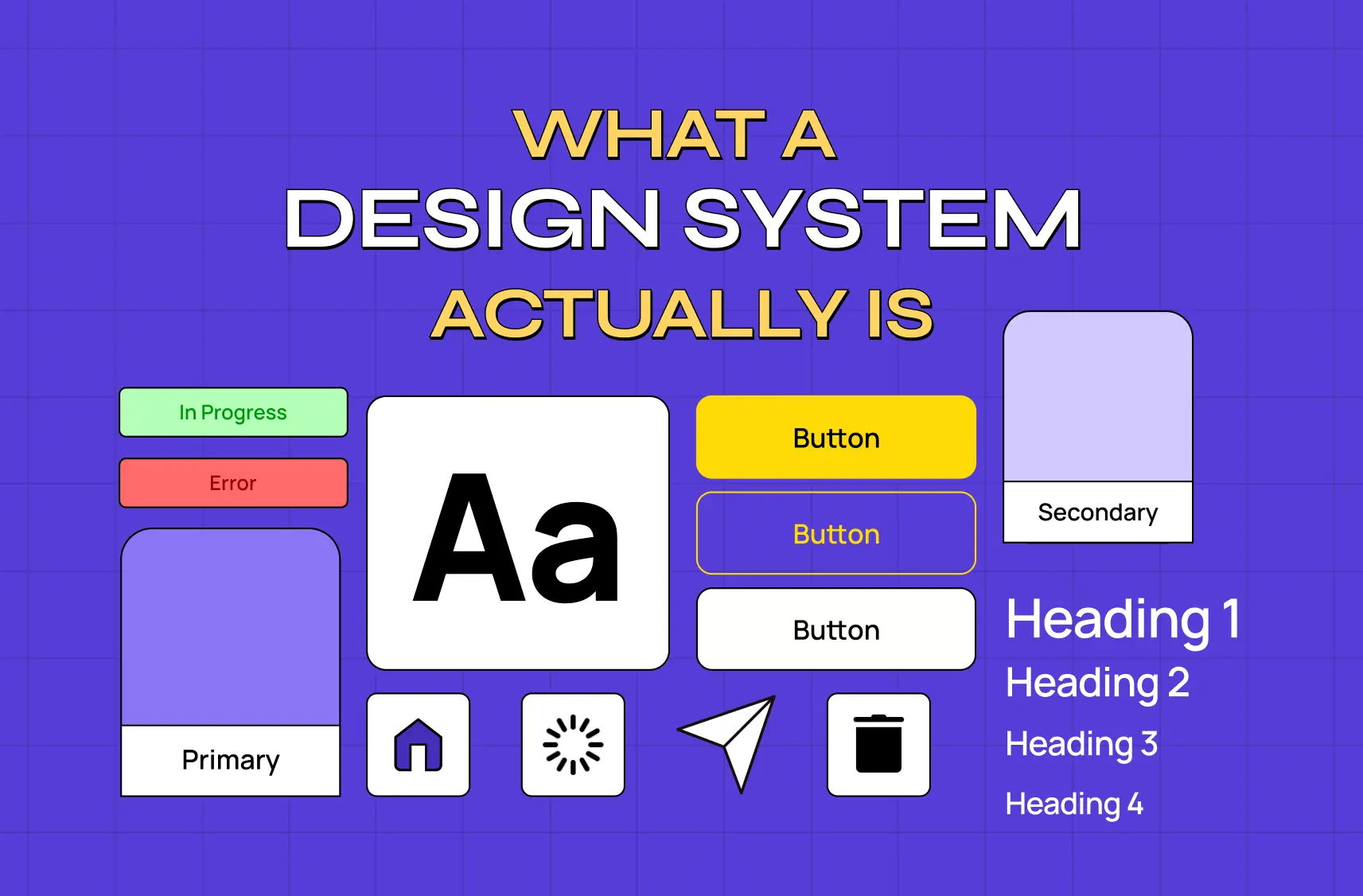
The foundation is a design system in the proper sense, meaning components plus tokens plus rules plus documentation, rather than a Figma file full of symbols. A specialist is the person who keeps those four things in step with each other. When the component changes, the token changes, the documentation changes and the rule changes, all in the same week. Most systems decay because three of those four happen and the fourth quietly does not.
The other half of the job is holding the line. Every product team eventually wants an exception, usually for a deadline, and usually with a reasonable argument attached. Saying yes to the right ones and no to the rest is what keeps a common set of design principles meaningful rather than aspirational.
The work, week by week
A typical week splits across six kinds of work, and the balance between them tells you a lot about how healthy the system is. A specialist spending most of their time building is early in the system's life. One spending most of it supporting is either at scale or under-resourced.
Component work. Building new components, extending existing ones, and refactoring the ones that have accumulated variants nobody uses. The output is usually high-fidelity components with every state specified, not just the happy path, because the states are what the system is actually for.
Token and foundation maintenance. Colour, type, spacing, elevation and motion, kept consistent across light and dark themes and across whatever platforms you ship on.
Support. Answering questions in a channel, reviewing designs for system compliance, and unblocking teams who cannot find what they need. This is the part that quietly consumes the role.
Documentation. Usage guidance, do and do not examples, accessibility notes, and migration instructions when something changes.
Governance. Deciding what gets into the system and what stays local to one product. Running a request process. Communicating deprecations early enough that nobody is surprised.
Tooling. Keeping the library healthy in whichever platform you work in, and making sure the right design tools are set up so adoption is the easy path rather than the disciplined one.
That last point is worth sitting with, because it is the difference between a system people use and one they work around. If finding and inserting the correct component takes longer than rebuilding it, people rebuild it, and no amount of documentation or reminding changes that. Good specialists spend real time on the plumbing for exactly this reason.
How the role differs from a product designer
This comes up in almost every hiring conversation, and getting it wrong is expensive in both directions.
The clearest way to put it: a product designer solves a user problem inside one product area. A design system specialist solves the same problem once, for every product area, and then maintains that solution for years.
Product designers work in features and flows, measured by whether the feature works. A specialist works in components and rules, measured by adoption, consistency and how fast other people can ship. Those are different jobs with different success metrics, and people who are excellent at one are not automatically suited to the other.
The practical difference shows up in temperament. System work rewards patience, written communication and a tolerance for maintenance that most product designers find unrewarding. It is closer to platform engineering than to feature design.
Specialist, systems designer, design system engineer or lead?
Four titles, four different jobs, and a search engine that cannot reliably tell them apart.
Title | What it actually is | Where it sits |
Design system specialist | Owns the component library, tokens and documentation. Design-side, may or may not code. | Design team |
Design systems engineer | Builds and maintains the coded component library. Front-end engineer with system focus. | Engineering team |
Design systems lead | Runs the system as a programme. Strategy, roadmap, adoption, stakeholders. Often manages both of the above. | Design or platform leadership |
Systems designer | Usually game design. Designs rules, economies and progression systems. Unrelated. | Game studio |
System design specialist | Networking, IT infrastructure or hardware systems. Entirely unrelated. | IT or engineering |
This is not a pedantic distinction. Glassdoor's own design system specialist page bleeds system design specialist listings into its results, and ZipRecruiter prices that networking role at $43,000 to $102,000. If you are benchmarking a salary or scanning job listings, check which job the number describes before you use it, because the aggregators are blending two bands that are roughly $50,000 apart.
What a Design System Specialist Earns

All figures below are from Glassdoor's United States salary pages, quoted as published.
Role | Total pay range | Median total pay | Base pay range | Salaries reported |
Design system specialist | $73,000 to $132,000 | $98,000 | $61,000 to $109,000 | 44 |
Design systems engineer | $133,000 to $201,000 | $163,000 | $114,000 to $166,000 | 50 |
Design systems lead | $134,000 to $205,000 | $165,000 | $112,000 to $164,000 | thin sample |
Three things to read off this before you budget anything.
The code side pays substantially more. A design systems engineer's median sits roughly $65,000 above a design system specialist's. If your system's hardest problems are in the coded library rather than in the Figma library, you are hiring from a more expensive market than the title suggests.
The lead figure rests on a thin sample. Glassdoor's design systems lead page reports a headline range but surfaces only a handful of individual salaries behind it. Treat it as directional. The engineer and specialist samples, at 50 and 44, are more reliable.
The lead and engineer bands overlap almost entirely. That tells you something real about how these teams are structured: seniority in design systems is often lateral rather than vertical, and a strong engineer and a lead are paid comparably because both are scarce.
Why the aggregators disagree with each other
ZipRecruiter's national average for design system roles is $118,589, with a median of $117,800 and a quoted range of $49,500 to $173,500. That is a different number from Glassdoor's, and the reason is worth understanding before you use either.
ZipRecruiter is matching on the phrase rather than on a single job title, so its figure blends specialists, engineers, leads and the unrelated networking roles into one average. Glassdoor separates by title but then has smaller samples per title. Neither is wrong. They are measuring different things.
For a salary benchmark, use Glassdoor's per-title figures. For a sense of the whole market's shape, ZipRecruiter's spread is useful, and its $49,500 floor is almost entirely the networking role rather than anything to do with design.
How Design System Teams Are Structured in 2026

This is where the role has changed most, and where advice written even two years ago is now misleading.
The team models most companies still reference were built when documentation, component grunt work and design QA consumed a large share of a specialist's week. AI tooling has absorbed a meaningful part of that, which means the headcount question has shifted. It is no longer how many people do we need. It is how much ground one person can now cover.
The practitioner view worth reading on this is Romina Kavcic's work on design system team structure, which argues that the traditional models are obsolete and puts rough capacity figures against each team size. These are her observations rather than survey data, so treat them as experienced estimates, but they match what we see.
The solo specialist, and its ceiling
One person with good tooling can maintain roughly 20 to 40 components properly. That covers a single product with a focused surface area.
The ceiling arrives faster than people expect, and it is not component count. It is the number of teams asking questions. Once a solo specialist is supporting several product teams, support eats the week and the system stops moving. A specialist serving more than a handful of teams, or a developer population in the hundreds, is a model that is already failing quietly.
The three-person team
Three people cover roughly 50 to 100 components with a regular release cadence and several consuming product teams.
The shape that works now is a lead who is mostly strategic, a systems engineer on the coded library, and a design engineer bridging the two. That is different from the equivalent team a few years ago, which typically ran a hands-on lead, an engineer, and a design ops or programme person. The programme work has not disappeared. It has been absorbed into tooling and into the lead's remit.
The ten-person team
At enterprise scale the team stratifies into layers rather than growing evenly. A strategic layer with a director, a programme manager and an adoption lead. A design layer. An engineering layer with a manager and platform and front-end engineers. Then specialists, with accessibility being the one that is almost always worth a dedicated person at this size.
This is also the point where the system stops being a library and becomes infrastructure. If you are heading here, a growth-ready design system is a different brief from a component library, and it is better to architect for it early than to retrofit governance onto something that grew organically.
What AI changed about this role
Three shifts worth knowing if you are hiring, or if you are considering this career.
Documentation stopped being a bottleneck. Writing and maintaining usage guidance used to consume a substantial slice of a specialist's week. Generating a first draft is now fast. Reviewing it for accuracy still is not, but the balance has moved.
The scarce skills moved up the stack. Adoption, governance, accessibility and developer experience became more valuable, because those are judgement problems rather than production problems. Deciding what belongs in the system is still entirely human work.
Some roles merged. The standalone technical writer on a design system team is increasingly rare. So is the pure visual designer, whose work is now a smaller part of a role that is mostly systems thinking.
The practical consequence for hiring: a specialist who is strong on governance and adoption is worth more than one who is fast at building components, which was not obviously true a few years ago.
Do You Actually Need One?
Not every team does, and hiring one too early is a real waste of money.
If you have one product, one designer and a Figma file that everyone can hold in their head, you do not need a dedicated specialist. You need discipline and a shared library. Applying proven product design best practices consistently will get you further than a hire will, and it costs nothing.
The role earns its keep when the cost of inconsistency starts exceeding the cost of the person. That crossover is more measurable than it sounds.
Signs your team is ready
Three or more of these and the case is already made.
A senior designer spends more than half their week answering component questions rather than designing
The component request backlog is months long, and teams have started building their own instead of waiting
The same button, modal or form field exists in four variations across your product, and nobody can say which is correct
Engineers routinely rebuild components that already exist because they cannot find or trust the originals
Every release cycle includes a handoff bottleneck where design and engineering reconcile things that should have matched already
You are expanding to a second platform, a second product, or an acquisition, and nothing is shared
Accessibility fixes keep being applied per screen rather than per component, so the same issue recurs
The four benefits that hold up
We have cut this list down deliberately. Plenty of articles list ten benefits. Four of them survive contact with a finance team.
Consistency stops eroding. Without an owner, systems drift. Someone ships a one-off variant under deadline pressure, it gets copied, and within a year you have four versions of the same thing. An owner makes visual consistency a maintained state rather than a periodic cleanup project.
Handoff gets shorter. When a component is specified once, with states and behaviour documented, the back-and-forth between design and engineering largely disappears for that component. The saving compounds because it applies to every future use.
Accessibility gets built in rather than bolted on. Fixing contrast, focus order and keyboard paths at the component level fixes them everywhere at once. Fixing them per screen means fixing them repeatedly, forever.
Your product designers get their time back. This is the one that matters most and gets argued least well. Every hour a senior designer spends rebuilding a date picker is an hour not spent on the problem you actually hired them for.
In-House, Freelance or Specialist Studio

Three models, and the cost comparison that usually gets made is the wrong one.
Model | Best for | What it really costs | Speed to start | Who owns it after |
In-house hire | A system that will keep growing for years, with multiple product teams consuming it | Salary per the table above, plus benefits and recruiting, as a permanent line | 2 to 4 months to hire | You, as long as they stay |
Freelancer | A defined piece of work with a clear end: an audit, a token migration, a component sprint | Lowest day rate of the three | Days to weeks | 🚩 Usually nobody. Governance tends to leave when they do |
Specialist studio | Building or consolidating a system, then handing it over | Scoped project cost, with no hiring lag | Weeks | You, with the governance model as a deliverable |
The comparison people usually run is hourly rate, and it is the least useful number of the three. Freelance rates vary so widely by region and seniority that a quoted band would not help you anyway.
The question that actually predicts cost is who owns the system in month seven.
A freelancer is the cheapest way to get a system built and frequently the most expensive way to have one a year later, because the rules that keep it coherent usually live in one person's head and leave with them. An in-house hire is the highest fixed cost and the only model where ownership is genuinely permanent, provided you can hire well and that person stays. A studio sits in between, and the thing to insist on is that the governance model, the request process and the documentation standard are explicit deliverables rather than things that happened to exist while the engagement ran.
If you want to pressure-test any proposal, how a design studio scopes and delivers work sets out what should be in scope, which is a useful list to hold a statement of work against.
Most teams end up running a hybrid. A studio or contractor builds the foundation, an internal person inherits and extends it. That works, and it fails in one predictable way: the handover is treated as the last two weeks rather than as part of the engagement. Name the person who will inherit the system at the start, and have them in reviews from week one.
How to Evaluate a Design System Specialist
What to look for in a portfolio
Design system portfolios are harder to read than product design portfolios, because the good work looks unremarkable. Four things to ask to see.
A component with its full state matrix, not a hero shot of a library. Default, hover, focus, active, disabled, loading, error, empty. The states are where the thinking lives.
Documentation they wrote. Ask for a usage page. You will learn more about how they think from one well-written do-and-do-not section than from the entire Figma file.
Evidence of adoption, not just creation. How many teams used it, how they measured that, what they did when a team refused. Anyone can build a library. Getting people to use it is the job.
A deprecation they ran. How they removed something people depended on without breaking anything. This separates people who have maintained a system from people who have built one.
The red flag to watch for is a portfolio that is entirely components and no process. It usually means the system was a project rather than a practice.
What to put in the job description
If you are writing the role rather than hiring it out, the specifics that attract the right candidates and filter the wrong ones.
Name the scale: how many components, how many consuming teams, how many engineers
Say whether the role codes, and in what. Vagueness here wastes everyone's time
Say who owns the coded library if the specialist does not
Name the platform and the tooling
Say what the first ninety days look like, because experienced specialists are evaluating whether you have a real mandate
Be honest about the support load
How to Become a Design System Specialist
Most people arrive from one of two directions, and both work.
From product design. You get interested in the library, start maintaining it alongside your feature work, and gradually the library becomes the job. The gap to close is technical: tokens, theming, versioning, and enough front-end understanding to talk credibly with engineers.
From front-end engineering. You own the component library in code, start caring about how it is consumed, and move toward the design side. The gap to close is design judgement and the political work of adoption.
What to build toward, in rough order: fluency in a design tool's component and variable model; a real grasp of tokens and theming; accessibility to WCAG level, because this is increasingly the hardest requirement on any system; writing, since documentation is a substantial part of the output; and the governance skills, which nobody teaches and which decide whether you are good at this.
There is no certification worth chasing. The portfolio pieces that get people hired are a maintained system with evidence of adoption, and a deprecation handled well.
How Groto Approaches Design Systems

We run design system work in three stages, and we scope them separately so you can stop after any one of them.
Audit. What exists, what is actually used, where the duplication sits, and what it is costing you in rework. This is also the cheapest way to find out whether you need a system or just need to tidy one.
Define. Tokens, foundations and the component set, built to the scale you will be at in two years rather than the one you are at now.
Document and hand over. The governance model, the request process and the usage documentation, handed to a named person on your side who has been in the reviews from the start.
If your product is a subscription platform, design systems for products covers what changes when the system has to serve multiple plans, roles and permission states, which is where most SaaS systems get complicated.
Two things we insist on, because they are what make the difference a year later. The handover person is named at the start and sits in reviews from week one rather than week twelve. And the governance model is written down as a deliverable, not left as something that happened to work while we were there. Systems without either tend to revert.
If you want to talk through which of the three stages you actually need, our design system services page sets out how each one is scoped.
Conclusion
A design system specialist is a maintenance and governance role wearing a design title. The building is the visible part and the smaller part.
The US median sits at $98,000 for the design-side role and $163,000 for the coded equivalent, which is a bigger gap than most hiring plans account for. Before you benchmark either, check that the figure you are looking at describes the right job, because the salary sites routinely blend in a networking role that pays half as much.
And settle the question that actually predicts cost before you compare any two options: who owns the system in month seven. A system with no owner reverts to the state it was in before you built it, usually within a year, and then you pay for it twice.