The Best Mobile App UX Design Agencies for SaaS in 2026 (Ranked by Product Fit, Not Brand Name)

The Best Mobile App UX Design Agencies for SaaS in 2026 (Ranked by Product Fit, Not Brand Name)

Six mobile app UX design agencies for SaaS compared by fit, Clutch-checked pricing and 2026 platform readiness, with a scorecard to rate any shortlist.

The Best Mobile App UX Design Agencies for SaaS in 2026 (Ranked by Product Fit, Not Brand Name)

The Best Mobile App UX Design Agencies for SaaS in 2026 (Ranked by Product Fit, Not Brand Name)

Six mobile app UX design agencies for SaaS compared by fit, Clutch-checked pricing and 2026 platform readiness, with a scorecard to rate any shortlist.

Hiring for SaaS mobile is not hiring for a consumer app. We compare six agencies on fit, Clutch-checked pricing and readiness for iOS 26 and Material 3 Expressive, with a scorecard to rate your shortlist.

Compare six SaaS mobile UX agencies by fit, pricing and 2026 platform readiness.

TL;DR

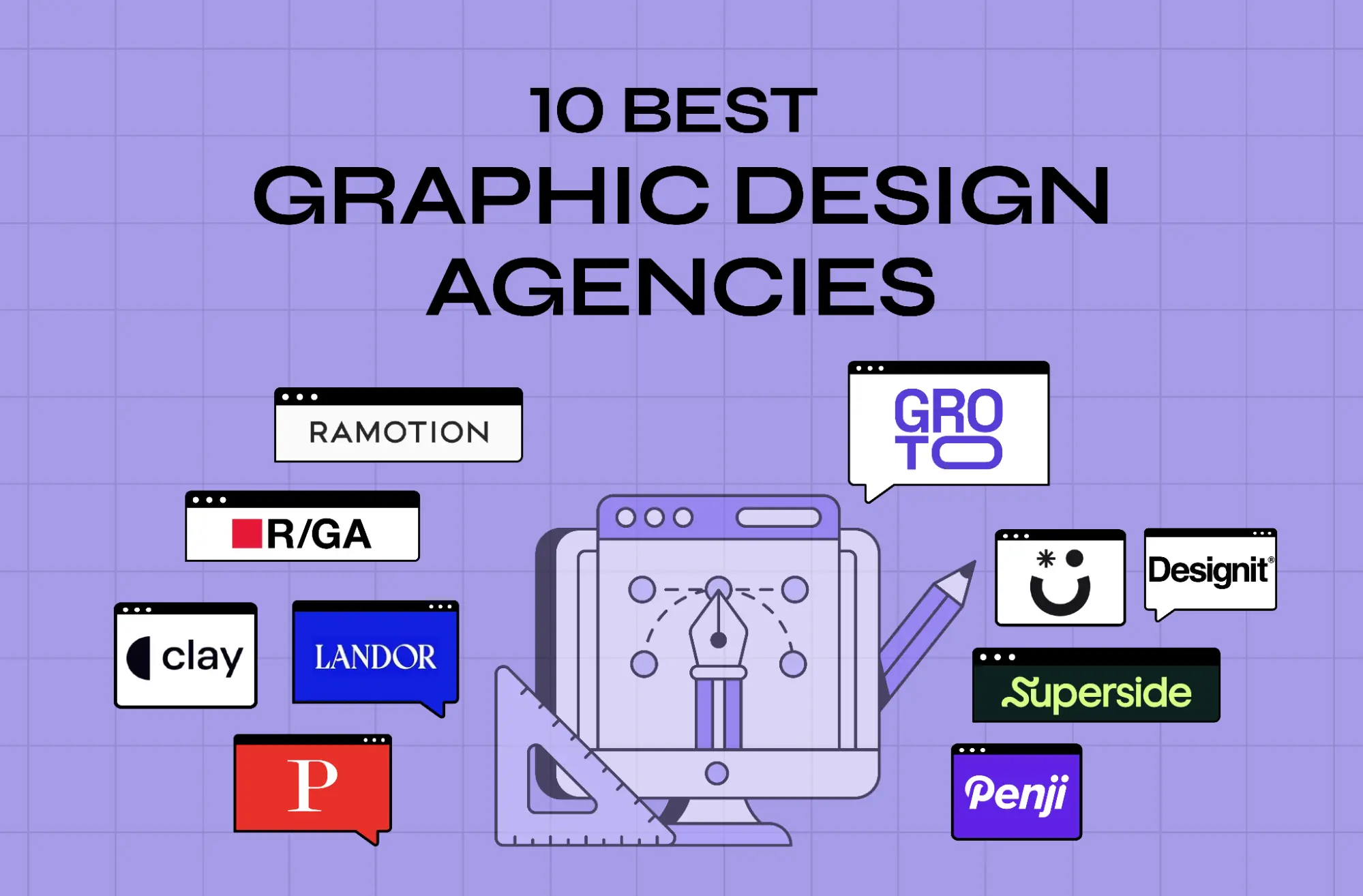
  • We ranked six agencies by SaaS mobile fit, not brand recognition: Groto, Eleken, WANDR, Ramotion, Goji Labs and Riseapps.

  • 2026 raised the bar. With iOS 26 and Material 3 Expressive, a design made once and shipped twice can look wrong on one platform.

  • Use the scorecard below to rate any shortlist out of 12 before the first call.

  • Rates and minimums come from Clutch profiles checked in October 2026.

  • If onboarding completion or return use is weak on mobile, start with an audit before a rebuild.

Hiring a mobile app UX design agency for a SaaS product is a different job from hiring one for a consumer app. SaaS users open the app to approve something, check a status or respond to an alert, then go back to desktop. An agency tuned for browsing and delight will get those moments wrong.

This list ranks six agencies on how well they handle that problem.

What Changed for SaaS Mobile UX in 2026

Four shifts change how you should judge an agency this year. For the full trend picture, read our guide to the 2026 mobile design shifts.

  • Two platform design languages, moving apart. Apple's iOS 26 introduced Liquid Glass, and Dezeen reports that buttons, switches and sliders became translucent and behave like glass. Google's Material 3 Expressive rests on 46 studies with more than 18,000 participants, and Google says people spot key interface elements up to four times faster. Google calls it an evolution of Material 3, not a new version. In practice, iOS contrast and navigation need fresh testing, and Android components, shape and motion differ.

  • Accessibility is a legal question for some products. The European Accessibility Act has applied since 28 June 2025 to consumer services such as e-commerce and consumer banking delivered through mobile apps. Pure B2B SaaS may sit outside scope, but if your app serves EU consumers in those categories, ask how the agency tests for accessibility.

  • AI now lives inside mobile flows. Summaries, suggested actions and agent approvals add states to design: loading, low confidence, error and undo. An agency that only draws the happy path will miss them.

  • Notification-led sessions. In our experience, SaaS mobile sessions are short and task-bounded, and often start from a push notification. Exploratory navigation and long scroll formats work against that.

How to Score a Mobile SaaS UX Agency Before You Shortlist

Screens do not separate one mobile app UX design agency from another. Evidence does. Score each agency 0 (no answer), 1 (generic answer) or 2 (specific, named evidence).

Criterion

A 2 looks like

A 0 looks like

Audit before design

Names the data it reviews first: sessions, drop-off, flow failures

Starts with moodboards or screen counts

SaaS mobile fluency

Explains how short, task-bounded sessions change navigation and density

Applies consumer patterns to a B2B product

Outcome evidence

Shows a metric that moved and the design change behind it

Shows screens only


Platform currency

Shows a shipped screen for Liquid Glass and one for Material 3 Expressive

Shows the same screen on both platforms

Handoff quality

Specs for empty, loading and error states, with separate iOS and Android notes

Final screens only

Engagement fit

Model matches how well you know your scope

Pricing stays vague until after you sign

Reading your total: 10 to 12 means shortlist. 7 to 9 means ask follow-up questions. 6 or below means pass.

Before you score anyone, review the agency skills to vet and check what agencies deliver so you know what a complete handoff contains. Evaluating agency portfolios works best when you read for metrics, not screens, and our guide to Evaluating agency portfolios shows how.

When to Hire a Mobile UX Agency for Your SaaS Product

  • You are building your first mobile product. Porting the desktop experience to a smaller screen is the costliest mistake here. A mobile app design agency with SaaS experience will rethink scope, architecture and interaction from the start.

  • Your mobile product exists but underperforms. Weak onboarding completion, low return use against installs, or core flows that need too many taps all point to a design problem that an audit can locate.

  • Mobile is becoming a primary surface. When mobile grows as a share of usage, you need a partner who understands SaaS UX scope across both surfaces, or a rebuild will follow.

1. Groto: Best for SaaS Mobile UX Built Around Workflows
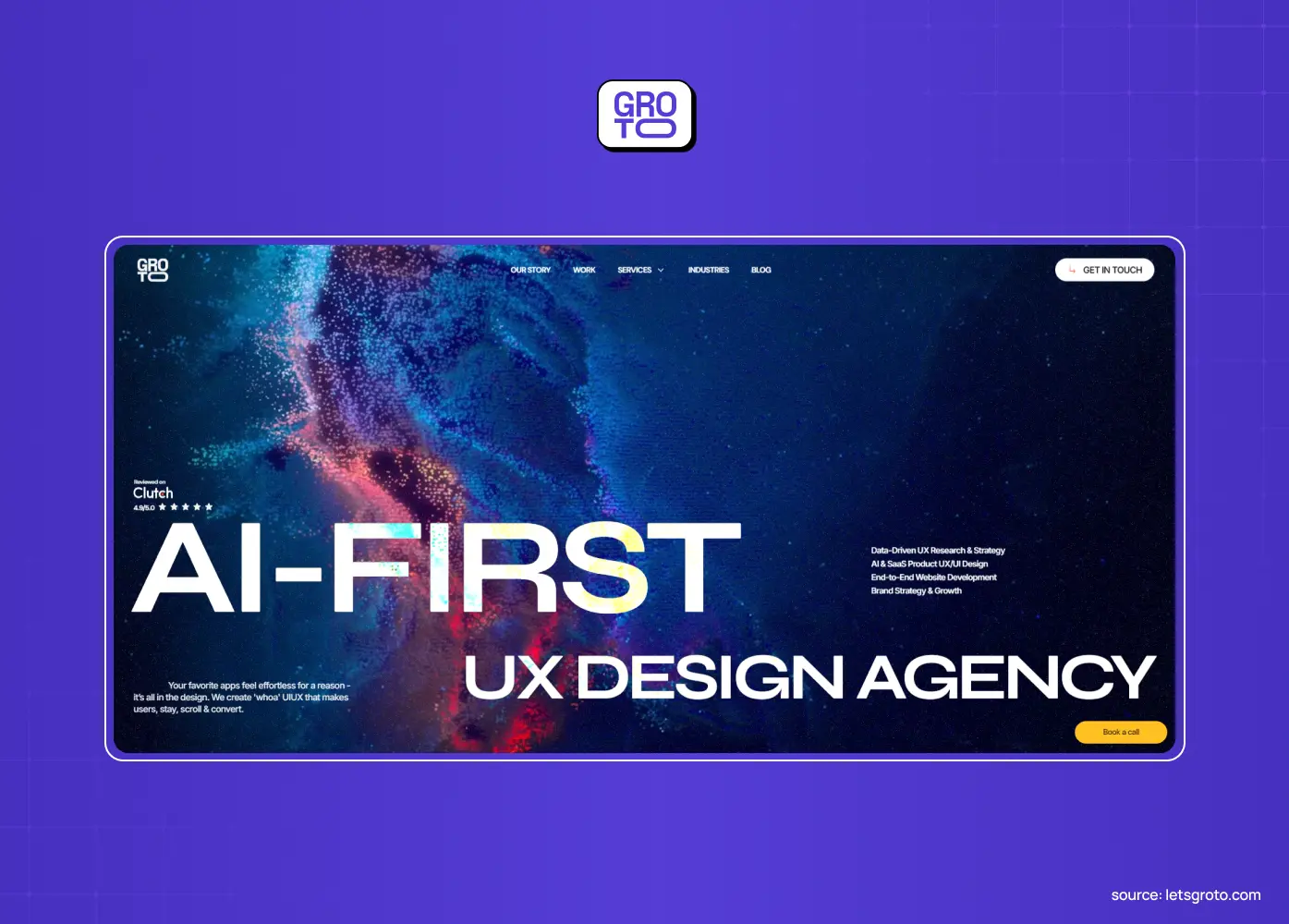
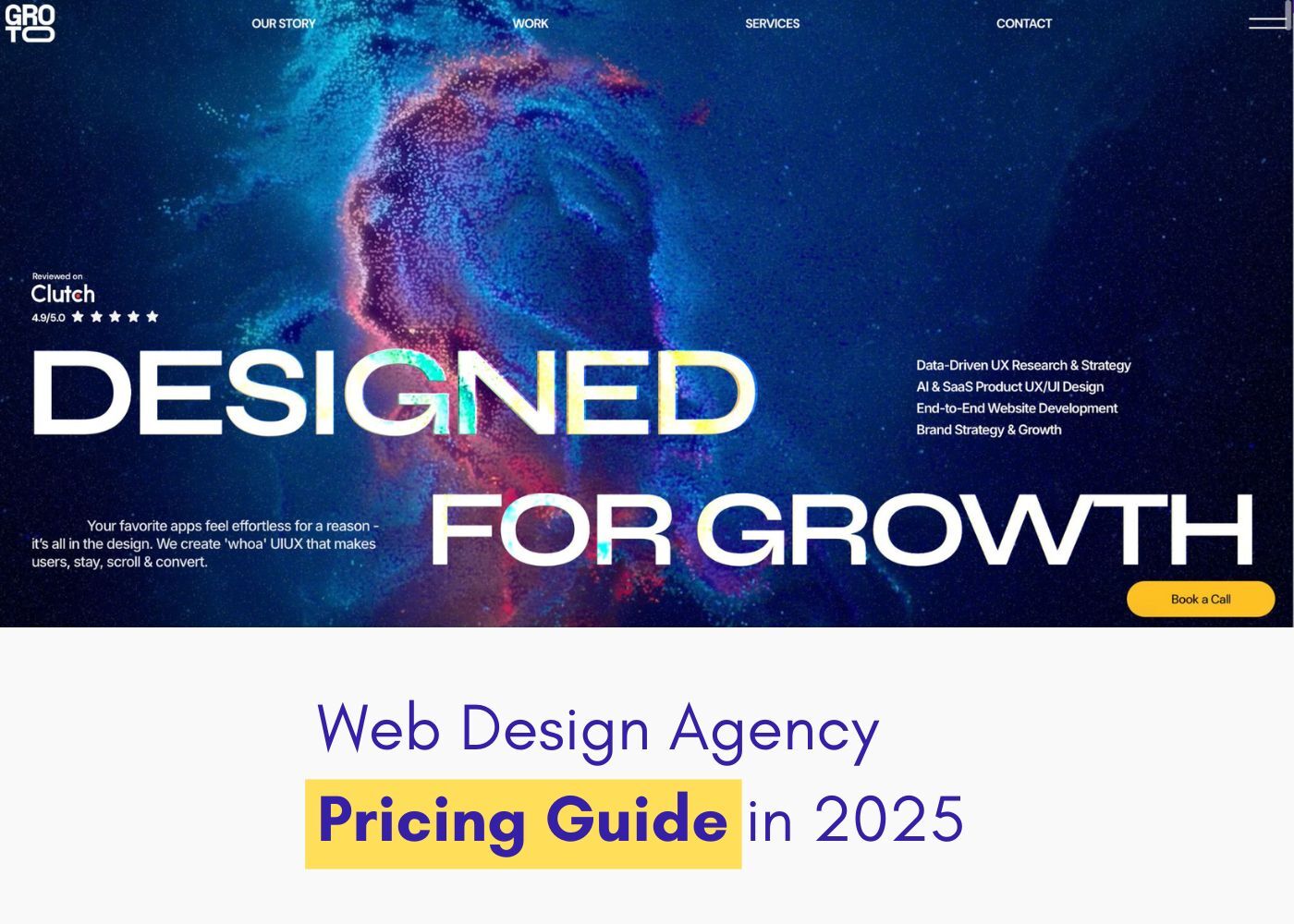
Groto’s AI-first UX design agency website featuring bold typography, a vibrant blue particle visual, and a dark, immersive hero section.

Groto is an AI-first UX/UI design studio and mobile app UX design agency for SaaS and AI products. Our Mobile Moment Stack maps every SaaS interaction to a decision, check-in or alert moment, so we decide what belongs on mobile before designing a single screen.

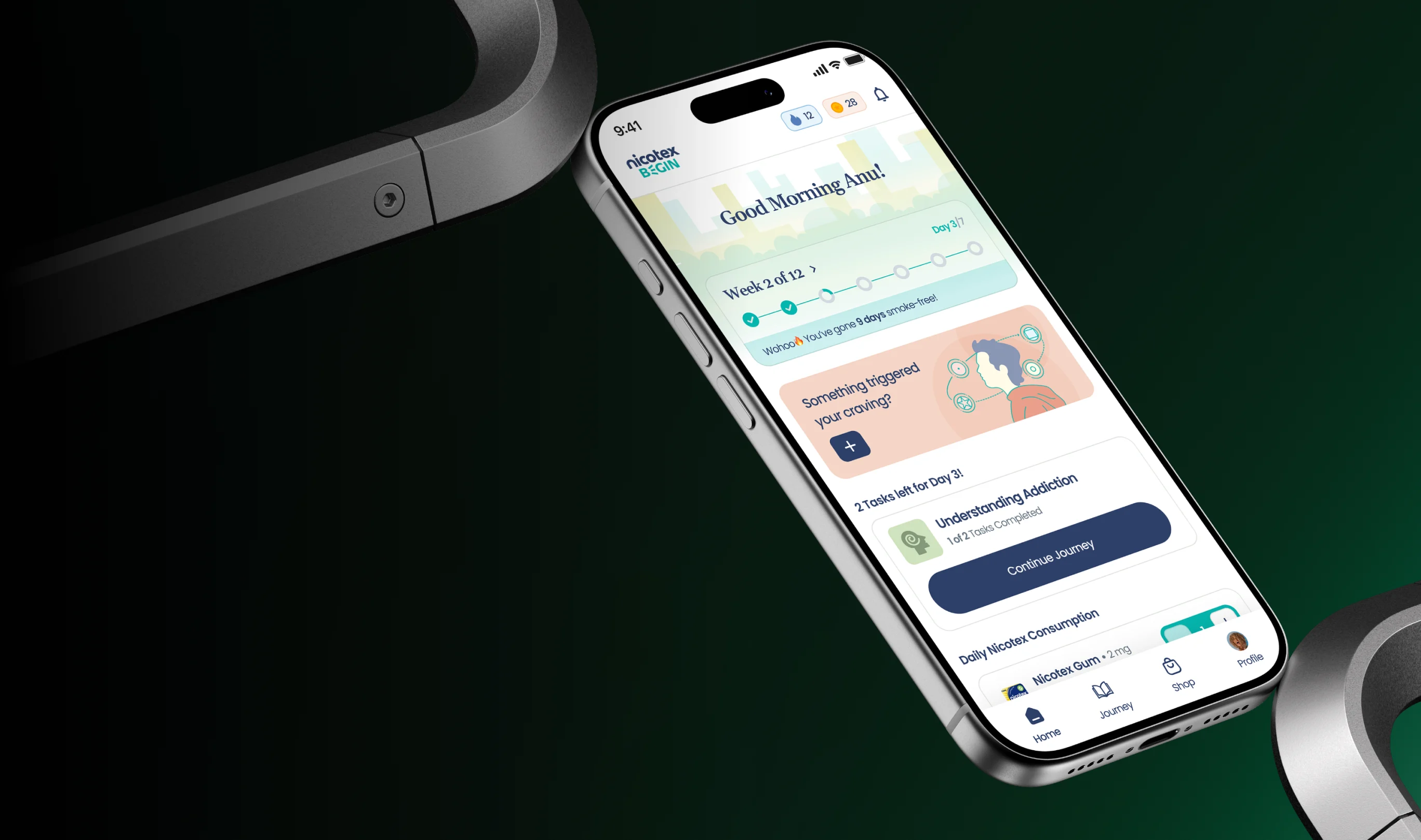
Our work on the Nicotex Begin app tackled onboarding drop-off with simpler flows and progressive disclosure. For PolicyBazaar, we built the mobile experience first, then extended it to desktop.

Best for: SaaS teams that need bespoke mobile UX, especially multi-role products and workflow-heavy apps.

Pros: Audit-first process, a named framework for deciding what belongs on mobile, flexible subscription engagement.

Limitation: Design only. Mobile engineering sits with your developers or another partner.

Want to know where your users are dropping off?

We’ll break down the exact moments users lose interest, and why.

Want to know where your users are dropping off?

We’ll break down the exact moments users lose interest, and why.

2. Eleken: Best for Ongoing SaaS Design Support
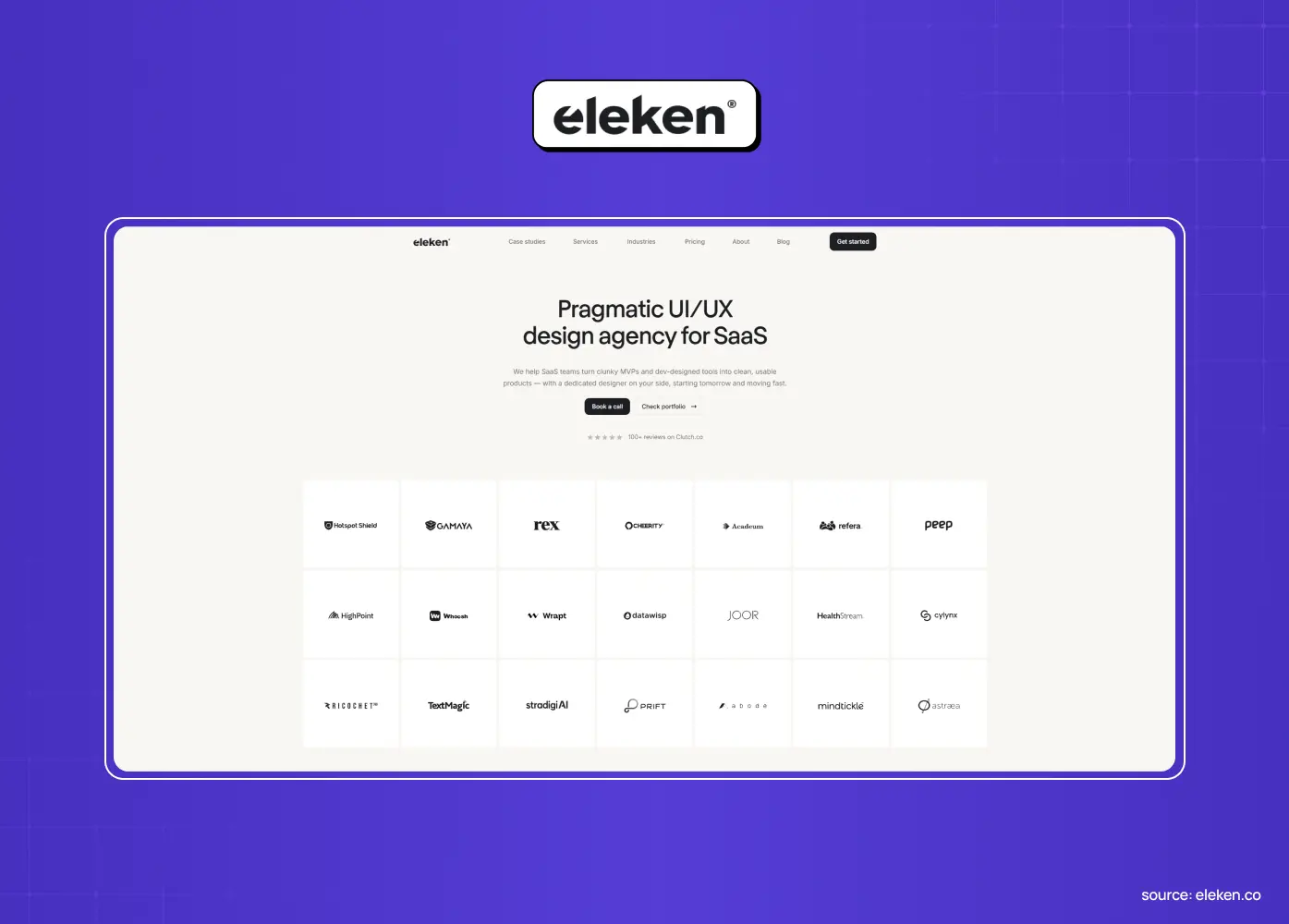
Eleken’s SaaS UI/UX design agency website showcasing a clean layout, minimalist typography, and a grid of client logos.

Eleken is a Ukraine-based design partner that works with SaaS businesses. Clutch lists a $10,000+ minimum project size and a $25 to $49 hourly rate, with most projects landing between $10,000 and $49,999.

Reviewers describe work across B2B SaaS, healthcare software and AI platforms, including a mobile app prototype built in Figma. Mobile is one surface among many in this portfolio, so expect a responsive-first approach rather than a mobile-moment approach. Teams weighing a monthly model against a fixed-scope sprint should also review the wider subscription design options.

Best for: SaaS startups with in-house developers that want steady, reliable design support.

Pros: SaaS-only focus, flexible engagement, broad SaaS portfolio.

Limitation: No development, and mobile is rarely the main brief.

3. WANDR: Best for Strategy Before Design

Wandr’s product design agency website featuring bold typography, a minimalist grid background, floating project previews, and teal accents.

WANDR is a Los Angeles product strategy and UX agency. Clutch lists a $25,000+ minimum and a $150 to $199 hourly rate, with project costs reported between $5,000 and $180,000.

Reviewers cite a UI and design system for a global cinema chain's app, UX for B2B SaaS products and a 4-week startup bootcamp for a real estate SaaS company. That mix suits teams whose mobile scope is still unclear and needs shaping before design. Teams in regulated categories should also weigh financial product UX firms, where discovery must account for compliance.

Best for: Growth-stage B2B SaaS companies that need strategic clarity before committing to a mobile build.

Pros: Discovery-led engagements, strong B2B SaaS exposure.

Limitation: Premium rates for early-stage budgets, and no stated mobile specialism.

4. Ramotion: Best for Brand and Product Together
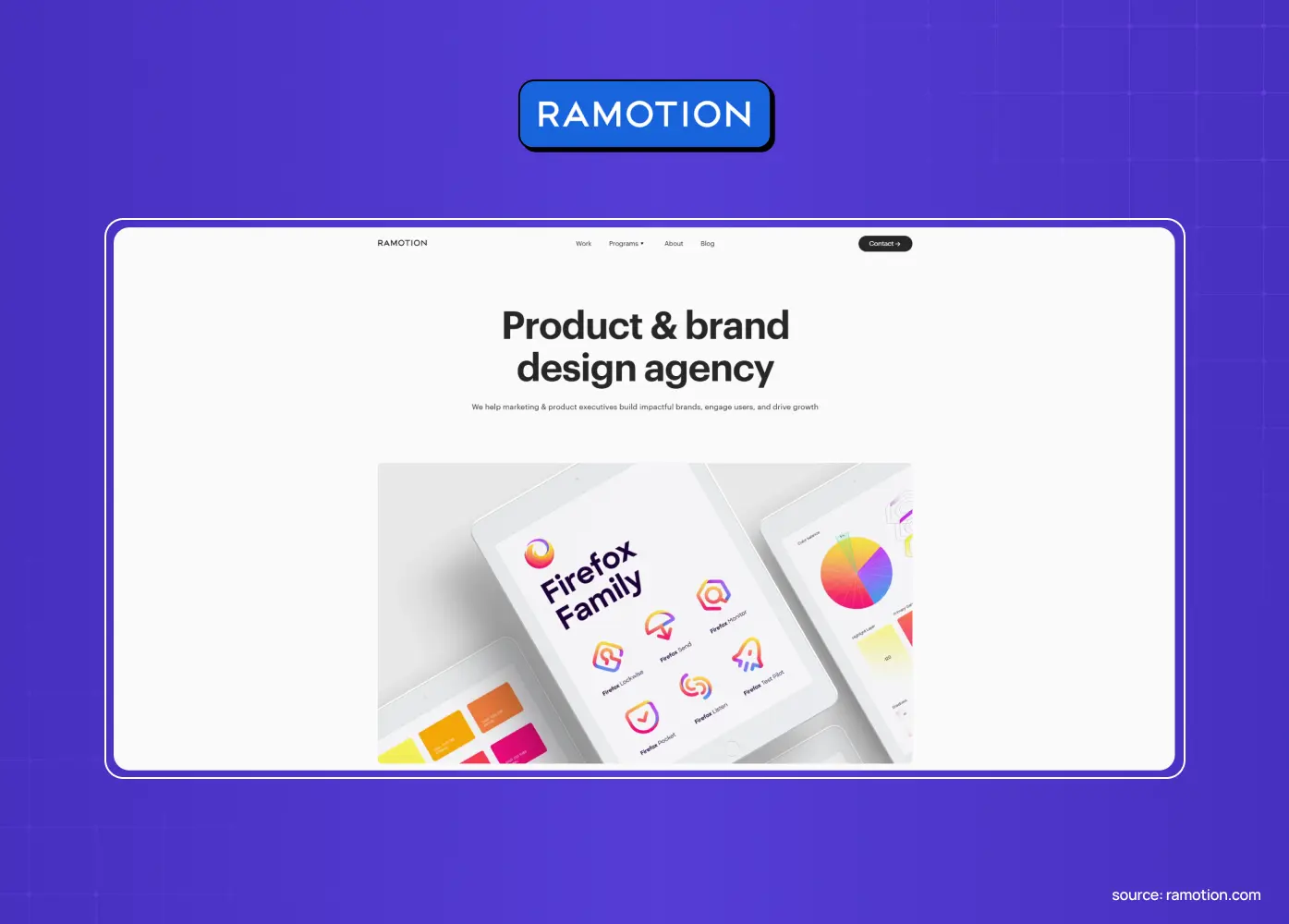
Ramotion’s product and brand design agency website featuring a clean white layout, centered headline, and colorful product interface mockups.

Ramotion is a San Francisco digital product agency covering branding, web, UI/UX and engineering. Clutch lists a $50,000+ minimum and a $150 to $199 hourly rate, with project costs from $12,000 to above $150,000.

Reviewers mention a payment mobile app built from scratch for a direct-to-consumer platform and an e-commerce app redeveloped for Android and iOS. Clutch summaries also note room for improvement on timelines. It fits when a funded SaaS company is refreshing its identity alongside a mobile build, and teams heading toward enterprise complexity should compare large-scale UX partners as well.

Best for: Funded SaaS companies that want brand identity, product design and engineering in one engagement.

Pros: Brand and product design under one roof, engineering included.

Limitation: Higher cost, and less suited to lean, iterative sprints.

 5. Goji Labs: Best for Mobile-Led Product Teams

Goji Labs’ product agency website featuring a minimalist layout, geometric grid background, and oversized black typography.

Goji Labs is a Los Angeles digital product agency that designs and builds mobile and web products. Clutch lists a $25,000+ minimum and a $100 to $149 hourly rate, with project costs ranging from $10,000 to over $600,000.

Reviewers describe UI/UX design and app builds for a fitness motivation app, a financial literacy foundation's mobile and web app and a sports stock market app. Clutch puts about half of its work in mobile app development, and lists UX strategy, user research and usability testing among its services.

Best for: SaaS teams with a mobile-led product that want research-backed design and iOS or Android builds from one partner.

Pros: Mobile-heavy portfolio, UX research and usability testing offered, design and build under one roof.

Limitation: Much of the reviewed work is consumer-facing, so ask for B2B SaaS examples.

6. Riseapps: Best for a Fast First Mobile Build

Riseapps’ healthcare AI agency website featuring a dark blue interface, abstract flowing wave graphics, and cards highlighting business outcomes.

Riseapps is a Kyiv-based studio that handles design and development together. Clutch lists a $50,000+ minimum and a $50 to $99 hourly rate, and notes Scrum-based delivery.

Reviewers describe healthcare, wellness and social apps built end to end, including UI/UX design for a social networking platform. One team handling design and code reduces handoff friction for early-stage products with a defined brief, though teams that prefer a subscription feel should also look at creative agency alternatives.

Best for: Early-stage SaaS teams with a defined brief that want design and build from one team.

Pros: One team for design and development, Scrum process.

Limitation: Design is one service inside a build-led offer, so strategy and audit depth may be lighter.

Agency Comparison at a Glance

Agency

Best for

Clutch minimum

Clutch hourly rate

Groto

Workflow-led SaaS mobile UX

$5,000+

$50

Eleken

Ongoing SaaS design support

$10,000+

$25 to $49

WANDR

Strategy before design

$25,000+

$150 to $199

Ramotion

Brand and product together

$50,000+

$150 to $199

Goji Labs 

Mobile-led product teams 

$25,000+

$100 to $149 

Riseapps

Fast first mobile build

$50,000+

$50 to $99

What Mobile SaaS UX Design Costs

When you hire a mobile app UX design agency, price follows engagement model more than screen count. The table groups the six agencies by how they charge. For a wider view of market rates, see our agency pricing benchmarks.

Model

Agencies

Starting point

Monthly subscription

Groto

$5,000+

Project, lower tier

Eleken

$10,000+

Project, mid tier

WANDR, Goji Labs

$25,000+

Project, build included

Ramotion, Riseapps

$50,000+

Here is what you should receive in each phase of a typical engagement:

Phase

What happens

What you should receive

Audit

Review of sessions, drop-off and flow failures

Prioritized list of friction points

Flows

Task flows for core mobile moments

Flows including empty and error states

Prototype

Interactive designs tested on real devices

Tested prototype and component foundations

Handoff

Specs for engineering

Component specs and separate iOS and Android notes

Hidden costs to ask about:

  • Late changes to a core flow after the prototype is built.

  • Adapting one platform's design for the other.

  • Rework when a platform design language changes.

  • Accessibility fixes found late.

Red Flags When Hiring a Mobile UX Agency

  • They go straight to screens and skip discovery.

  • They cannot explain how SaaS mobile differs from consumer mobile.

  • Their portfolio shows no outcomes.

  • They promise strength in everything from brand to engineering.

  • Pricing stays vague until you sign.

  • Their newest work predates iOS 26 and Material 3 Expressive.

How to Choose by Situation

  • First mobile product, unclear scope: Start with an audit, then scope the build. Groto or Goji Labs fits.

  • Ongoing design across the product: Compare SaaS-focused agencies, with Eleken as a starting point.

  • Brief undefined, complex B2B workflow: WANDR. Work through an agency hiring checklist first so you arrive with the right questions.

  • Funded, needs brand and build together: Ramotion.

  • Defined brief, one team for design and code: Riseapps.

  • Existing mobile product underperforming: Audit first, then fix the two or three highest-impact flows before any rebuild.

Conclusion

  • SaaS mobile needs a mobile app UX design agency that decides which moments belong on mobile before it draws screens.

  • The six agencies here each bring real value. The right one depends on your stage, budget and whether you need design only or design plus build.

  • Score every shortlist with the scorecard and ask for shipped work on both iOS 26 and Android.

  • Groto is the strongest fit for teams that need mobile UX designed around real workflows, not compressed desktop navigation.

  • Book a discovery call with Groto to find out what is breaking in your mobile UX and what it would take to fix it.

Hiring for SaaS mobile is not hiring for a consumer app. We compare six agencies on fit, Clutch-checked pricing and readiness for iOS 26 and Material 3 Expressive, with a scorecard to rate your shortlist.

Compare six SaaS mobile UX agencies by fit, pricing and 2026 platform readiness.

TL;DR

  • We ranked six agencies by SaaS mobile fit, not brand recognition: Groto, Eleken, WANDR, Ramotion, Goji Labs and Riseapps.

  • 2026 raised the bar. With iOS 26 and Material 3 Expressive, a design made once and shipped twice can look wrong on one platform.

  • Use the scorecard below to rate any shortlist out of 12 before the first call.

  • Rates and minimums come from Clutch profiles checked in October 2026.

  • If onboarding completion or return use is weak on mobile, start with an audit before a rebuild.

Hiring a mobile app UX design agency for a SaaS product is a different job from hiring one for a consumer app. SaaS users open the app to approve something, check a status or respond to an alert, then go back to desktop. An agency tuned for browsing and delight will get those moments wrong.

This list ranks six agencies on how well they handle that problem.

What Changed for SaaS Mobile UX in 2026

Four shifts change how you should judge an agency this year. For the full trend picture, read our guide to the 2026 mobile design shifts.

  • Two platform design languages, moving apart. Apple's iOS 26 introduced Liquid Glass, and Dezeen reports that buttons, switches and sliders became translucent and behave like glass. Google's Material 3 Expressive rests on 46 studies with more than 18,000 participants, and Google says people spot key interface elements up to four times faster. Google calls it an evolution of Material 3, not a new version. In practice, iOS contrast and navigation need fresh testing, and Android components, shape and motion differ.

  • Accessibility is a legal question for some products. The European Accessibility Act has applied since 28 June 2025 to consumer services such as e-commerce and consumer banking delivered through mobile apps. Pure B2B SaaS may sit outside scope, but if your app serves EU consumers in those categories, ask how the agency tests for accessibility.

  • AI now lives inside mobile flows. Summaries, suggested actions and agent approvals add states to design: loading, low confidence, error and undo. An agency that only draws the happy path will miss them.

  • Notification-led sessions. In our experience, SaaS mobile sessions are short and task-bounded, and often start from a push notification. Exploratory navigation and long scroll formats work against that.

How to Score a Mobile SaaS UX Agency Before You Shortlist

Screens do not separate one mobile app UX design agency from another. Evidence does. Score each agency 0 (no answer), 1 (generic answer) or 2 (specific, named evidence).

Criterion

A 2 looks like

A 0 looks like

Audit before design

Names the data it reviews first: sessions, drop-off, flow failures

Starts with moodboards or screen counts

SaaS mobile fluency

Explains how short, task-bounded sessions change navigation and density

Applies consumer patterns to a B2B product

Outcome evidence

Shows a metric that moved and the design change behind it

Shows screens only


Platform currency

Shows a shipped screen for Liquid Glass and one for Material 3 Expressive

Shows the same screen on both platforms

Handoff quality

Specs for empty, loading and error states, with separate iOS and Android notes

Final screens only

Engagement fit

Model matches how well you know your scope

Pricing stays vague until after you sign

Reading your total: 10 to 12 means shortlist. 7 to 9 means ask follow-up questions. 6 or below means pass.

Before you score anyone, review the agency skills to vet and check what agencies deliver so you know what a complete handoff contains. Evaluating agency portfolios works best when you read for metrics, not screens, and our guide to Evaluating agency portfolios shows how.

When to Hire a Mobile UX Agency for Your SaaS Product

  • You are building your first mobile product. Porting the desktop experience to a smaller screen is the costliest mistake here. A mobile app design agency with SaaS experience will rethink scope, architecture and interaction from the start.

  • Your mobile product exists but underperforms. Weak onboarding completion, low return use against installs, or core flows that need too many taps all point to a design problem that an audit can locate.

  • Mobile is becoming a primary surface. When mobile grows as a share of usage, you need a partner who understands SaaS UX scope across both surfaces, or a rebuild will follow.

1. Groto: Best for SaaS Mobile UX Built Around Workflows

Groto’s AI-first UX design agency website featuring bold typography, a vibrant blue particle visual, and a dark, immersive hero section.

Groto is an AI-first UX/UI design studio and mobile app UX design agency for SaaS and AI products. Our Mobile Moment Stack maps every SaaS interaction to a decision, check-in or alert moment, so we decide what belongs on mobile before designing a single screen.

Our work on the Nicotex Begin app tackled onboarding drop-off with simpler flows and progressive disclosure. For PolicyBazaar, we built the mobile experience first, then extended it to desktop.

Best for: SaaS teams that need bespoke mobile UX, especially multi-role products and workflow-heavy apps.

Pros: Audit-first process, a named framework for deciding what belongs on mobile, flexible subscription engagement.

Limitation: Design only. Mobile engineering sits with your developers or another partner.

Want to know where your users are dropping off?

We’ll break down the exact moments users lose interest, and why.

2. Eleken: Best for Ongoing SaaS Design Support

Eleken’s SaaS UI/UX design agency website showcasing a clean layout, minimalist typography, and a grid of client logos.

Eleken is a Ukraine-based design partner that works with SaaS businesses. Clutch lists a $10,000+ minimum project size and a $25 to $49 hourly rate, with most projects landing between $10,000 and $49,999.

Reviewers describe work across B2B SaaS, healthcare software and AI platforms, including a mobile app prototype built in Figma. Mobile is one surface among many in this portfolio, so expect a responsive-first approach rather than a mobile-moment approach. Teams weighing a monthly model against a fixed-scope sprint should also review the wider subscription design options.

Best for: SaaS startups with in-house developers that want steady, reliable design support.

Pros: SaaS-only focus, flexible engagement, broad SaaS portfolio.

Limitation: No development, and mobile is rarely the main brief.

3. WANDR: Best for Strategy Before Design

Wandr’s product design agency website featuring bold typography, a minimalist grid background, floating project previews, and teal accents.

WANDR is a Los Angeles product strategy and UX agency. Clutch lists a $25,000+ minimum and a $150 to $199 hourly rate, with project costs reported between $5,000 and $180,000.

Reviewers cite a UI and design system for a global cinema chain's app, UX for B2B SaaS products and a 4-week startup bootcamp for a real estate SaaS company. That mix suits teams whose mobile scope is still unclear and needs shaping before design. Teams in regulated categories should also weigh financial product UX firms, where discovery must account for compliance.

Best for: Growth-stage B2B SaaS companies that need strategic clarity before committing to a mobile build.

Pros: Discovery-led engagements, strong B2B SaaS exposure.

Limitation: Premium rates for early-stage budgets, and no stated mobile specialism.

4. Ramotion: Best for Brand and Product Together

Ramotion’s product and brand design agency website featuring a clean white layout, centered headline, and colorful product interface mockups.

Ramotion is a San Francisco digital product agency covering branding, web, UI/UX and engineering. Clutch lists a $50,000+ minimum and a $150 to $199 hourly rate, with project costs from $12,000 to above $150,000.

Reviewers mention a payment mobile app built from scratch for a direct-to-consumer platform and an e-commerce app redeveloped for Android and iOS. Clutch summaries also note room for improvement on timelines. It fits when a funded SaaS company is refreshing its identity alongside a mobile build, and teams heading toward enterprise complexity should compare large-scale UX partners as well.

Best for: Funded SaaS companies that want brand identity, product design and engineering in one engagement.

Pros: Brand and product design under one roof, engineering included.

Limitation: Higher cost, and less suited to lean, iterative sprints.

 5. Goji Labs: Best for Mobile-Led Product Teams

Goji Labs’ product agency website featuring a minimalist layout, geometric grid background, and oversized black typography.

Goji Labs is a Los Angeles digital product agency that designs and builds mobile and web products. Clutch lists a $25,000+ minimum and a $100 to $149 hourly rate, with project costs ranging from $10,000 to over $600,000.

Reviewers describe UI/UX design and app builds for a fitness motivation app, a financial literacy foundation's mobile and web app and a sports stock market app. Clutch puts about half of its work in mobile app development, and lists UX strategy, user research and usability testing among its services.

Best for: SaaS teams with a mobile-led product that want research-backed design and iOS or Android builds from one partner.

Pros: Mobile-heavy portfolio, UX research and usability testing offered, design and build under one roof.

Limitation: Much of the reviewed work is consumer-facing, so ask for B2B SaaS examples.

6. Riseapps: Best for a Fast First Mobile Build

Riseapps’ healthcare AI agency website featuring a dark blue interface, abstract flowing wave graphics, and cards highlighting business outcomes.

Riseapps is a Kyiv-based studio that handles design and development together. Clutch lists a $50,000+ minimum and a $50 to $99 hourly rate, and notes Scrum-based delivery.

Reviewers describe healthcare, wellness and social apps built end to end, including UI/UX design for a social networking platform. One team handling design and code reduces handoff friction for early-stage products with a defined brief, though teams that prefer a subscription feel should also look at creative agency alternatives.

Best for: Early-stage SaaS teams with a defined brief that want design and build from one team.

Pros: One team for design and development, Scrum process.

Limitation: Design is one service inside a build-led offer, so strategy and audit depth may be lighter.

Agency Comparison at a Glance

Agency

Best for

Clutch minimum

Clutch hourly rate

Groto

Workflow-led SaaS mobile UX

$5,000+

$50

Eleken

Ongoing SaaS design support

$10,000+

$25 to $49

WANDR

Strategy before design

$25,000+

$150 to $199

Ramotion

Brand and product together

$50,000+

$150 to $199

Goji Labs 

Mobile-led product teams 

$25,000+

$100 to $149 

Riseapps

Fast first mobile build

$50,000+

$50 to $99

What Mobile SaaS UX Design Costs

When you hire a mobile app UX design agency, price follows engagement model more than screen count. The table groups the six agencies by how they charge. For a wider view of market rates, see our agency pricing benchmarks.

Model

Agencies

Starting point

Monthly subscription

Groto

$5,000+

Project, lower tier

Eleken

$10,000+

Project, mid tier

WANDR, Goji Labs

$25,000+

Project, build included

Ramotion, Riseapps

$50,000+

Here is what you should receive in each phase of a typical engagement:

Phase

What happens

What you should receive

Audit

Review of sessions, drop-off and flow failures

Prioritized list of friction points

Flows

Task flows for core mobile moments

Flows including empty and error states

Prototype

Interactive designs tested on real devices

Tested prototype and component foundations

Handoff

Specs for engineering

Component specs and separate iOS and Android notes

Hidden costs to ask about:

  • Late changes to a core flow after the prototype is built.

  • Adapting one platform's design for the other.

  • Rework when a platform design language changes.

  • Accessibility fixes found late.

Red Flags When Hiring a Mobile UX Agency

  • They go straight to screens and skip discovery.

  • They cannot explain how SaaS mobile differs from consumer mobile.

  • Their portfolio shows no outcomes.

  • They promise strength in everything from brand to engineering.

  • Pricing stays vague until you sign.

  • Their newest work predates iOS 26 and Material 3 Expressive.

How to Choose by Situation

  • First mobile product, unclear scope: Start with an audit, then scope the build. Groto or Goji Labs fits.

  • Ongoing design across the product: Compare SaaS-focused agencies, with Eleken as a starting point.

  • Brief undefined, complex B2B workflow: WANDR. Work through an agency hiring checklist first so you arrive with the right questions.

  • Funded, needs brand and build together: Ramotion.

  • Defined brief, one team for design and code: Riseapps.

  • Existing mobile product underperforming: Audit first, then fix the two or three highest-impact flows before any rebuild.

Conclusion

  • SaaS mobile needs a mobile app UX design agency that decides which moments belong on mobile before it draws screens.

  • The six agencies here each bring real value. The right one depends on your stage, budget and whether you need design only or design plus build.

  • Score every shortlist with the scorecard and ask for shipped work on both iOS 26 and Android.

  • Groto is the strongest fit for teams that need mobile UX designed around real workflows, not compressed desktop navigation.

  • Book a discovery call with Groto to find out what is breaking in your mobile UX and what it would take to fix it.

Have a project in mind?

Let’s talk through your idea and see what makes sense.
Harpreet Singh

Founder at Groto

Have a project in mind?

Let’s talk through your idea and see what makes sense.
Harpreet Singh

Founder at Groto

FAQ

Everything you were going to ask (and a few things you didn’t know to)

How long does a mobile app UX engagement take for a SaaS product?

It depends on scope and number of user roles. Our UX audit takes two weeks on Part-Time and Full-Time plans, and design work follows. Nicotex Begin ran 36 weeks end to end, while the PolicyBazaar project took four months. Ask any agency for a phase-by-phase estimate tied to your scope.

Do I need separate designs for iOS and Android?

You can share information architecture and task flows across both. Navigation, components, type and motion usually need platform-specific treatment, especially now that Liquid Glass and Material 3 Expressive differ. Confirm the quote includes separate specs for each platform.

What should I prepare before the first agency call?

Bring your mobile analytics, the top tasks users complete on mobile, onboarding completion figures and recent app store reviews. Note which flows you suspect belong on desktop. Agencies can give a sharper estimate and a more useful audit plan when they start from real data.

Does a mobile companion app need its own design system?

Usually it benefits from shared design tokens with the web product, such as color and type, plus platform-specific components. A fully separate system risks drift between surfaces. Ask the agency how it will keep the two aligned as the product grows.

Can I buy a mobile UX audit on its own?

Some agencies sell audits separately and some bundle them. At Groto the audit comes with Part-Time and Full-Time plans. Ask what the audit delivers, such as a prioritized list of friction points, and whether findings come with design recommendations.

How is AI changing mobile UX design work in 2026?

AI features add states to design, including loading, low confidence, error and undo, and they raise trust questions on small screens. AI tools can speed up exploration, but they do not replace research into what users do in short mobile sessions. Ask how an agency tests AI-driven flows.

More Articles

Extreme close-up black and white photograph of a human eye

Let’s bring your vision to life

Tell us what's on your mind? We'll hit you back in 24 hours. No fluff, no delays - just a solid vision to bring your idea to life.

Profile portrait of a man in a white shirt against a light background

Harpreet Singh

Founder and Creative Director

Get in Touch