10 Best UX Design Agencies in Toronto (2026): The Honest Shortlist for Founders & Product Teams

10 Best UX Design Agencies in Toronto (2026): The Honest Shortlist for Founders & Product Teams

Compare the 10 best UX design agencies in Toronto for 2026 by specialty, location and published pricing, with six questions to hire well.

10 Best UX Design Agencies in Toronto (2026): The Honest Shortlist for Founders & Product Teams

10 Best UX Design Agencies in Toronto (2026): The Honest Shortlist for Founders & Product Teams

Compare the 10 best UX design agencies in Toronto for 2026 by specialty, location and published pricing, with six questions to hire well.

Choosing a UX partner in Toronto is a high-stakes call. We compared 10 agencies on research depth, outcomes, accessibility and price, and flag where each fits best, so you can shortlist with confidence.

An honest 2026 shortlist of Toronto UX agencies, with pricing, red flags and hiring questions.

TL;DR

  • This shortlist compares 10 agencies by headquarters, specialty and fit, across SaaS, enterprise research, accessibility, digital health, fintech and web3.

  • We rank Groto first for outcome-led SaaS work. We are not a Toronto studio. We work with Toronto teams remotely, and we say so in our entry.

  • Published Canadian agency rates run from about $50 to $199 an hour, with minimum projects from $5,000 to $50,000, according to Craft Innovations' published profiles.

  • Use the 6 questions near the end on your first call. They separate a real design partner from an expensive vendor.

A UX design agency in Toronto is the partner most SaaS founders and product teams hire to turn research, user flows and interface design into a product people want to use. The market is crowded, from boutique studios to global firms. The real work is separating agencies that ship measurable outcomes from agencies that only ship screens.

The wrong choice costs more than a design fee. It costs a launch window and a round of engineering rework. So we built a criteria-first shortlist, followed by costs, a decision framework and the questions that expose a weak partner.

One note on bias. We are Groto, and we are on this list. We are also not based in Toronto. We held every agency to the same criteria, and we flag where a local studio is the better pick.

The shortlist at a glance

Grid of ten company logos, including Groto, Akéndi, Wavespace, Mindsea, Nextbrain, Interpix, Craft Innovations, M4R, and two additional brand marks, displayed in rounded cards against a purple grid background.

#

Agency

H

Best for

1

Groto

India (remote)

SaaS and AI product teams

2

Akendi

Toronto

Enterprise research and usability testing

3

Wavespace

Toronto

Accessibility-first SaaS design

4

Mindsea

Halifax

Mobile and digital health

5

Nextbrain Technologies

Toronto

Design and build under one roof

6

Interpix Design

Toronto

Established, senior UX craft

7

Makra Digital

Toronto

UX-led web design and conversion

8

Roobinium

Toronto

Web and web3 products

9

ROSSUL

Toronto

Enterprise UX and modernization

10

Craft Innovations

Toronto

Research-led fintech UX

How we chose these agencies

A strong agency should show five things:

  • Research-led process. Not just polished screens.

  • Measurable outcomes. Task completion, conversion and retention, not "we redesigned it."

  • Relevant industry experience. SaaS, fintech, healthtech, marketplaces.

  • Engineering-aware design. Work that survives contact with real developers.

  • Transparent pricing and scope.

This matters because a confusing onboarding flow does not throw an error. It shows up as lower activation three months later. Usability research has long held that fixing problems during design is far cheaper than fixing them after launch, so the right agency surfaces problems before your engineers build them.

If you want the wider buying checklist, our guide on how to choose the right agency covers it step by step.

The Toronto market in 2026

Toronto combines a large enterprise base in finance, insurance and telecom with a mature startup ecosystem. That mix produces three kinds of agency: research-heavy enterprise firms, product studios for startups and SaaS, and web-led shops focused on conversion.

A few things have shifted going into 2026:

  • AI now sits inside the brief. Buyers ask how an agency uses AI in research, prototyping and design systems, and expect it to show up in timelines and price.

  • AI product UX is its own skill. Copilots and agents need trust cues, error states and review steps that classic SaaS patterns do not cover.

  • Accessibility is a purchasing requirement. Enterprise and public-sector buyers screen for it early.

  • Language can matter. Products serving Quebec often need French support planned from the start.

Hiring locally still has real benefits:

  • Time-zone alignment for daily collaboration, not overnight handoffs.

  • Easier in-person workshops for discovery and stakeholder alignment.

  • Familiarity with Canadian accessibility and privacy expectations that offshore teams sometimes miss.

The trade-off is cost. A local agency usually costs more than a distributed team and less than a US coastal firm, such as those in the San Francisco Bay Area. Discovery workshops benefit from proximity. Execution usually does not. Hiring a UX design agency in Toronto makes the most sense when workshops and stakeholder access are central to the project.

The 10 best UX design agencies in Toronto

1. Groto: Best for SaaS and AI product teams that can work remotely

Groto’s AI-first UX design agency homepage featuring oversized white typography, vibrant blue and pink particle visuals, and a dark, immersive hero section.

HQ: India, working remotely with product teams.

We lead this list because we do what most agencies only claim to do: tie design decisions to product outcomes. Our work in SaaS UX design pairs user research and data with high-craft UI, so what lands in your codebase is validated, accessible and ready to convert. Our UI/UX design services treat discovery and execution as separate phases, so you never pay for polish before the problem is understood.

To be direct: if you need your designers physically in Toronto, pick one of the studios below. If remote works for you, we offer startup speed with enterprise rigor.

Known for:

  • Tying design decisions to product outcomes, not just visuals

  • Separating discovery and execution into distinct phases

  • Working with SaaS companies, startups and VC-backed teams

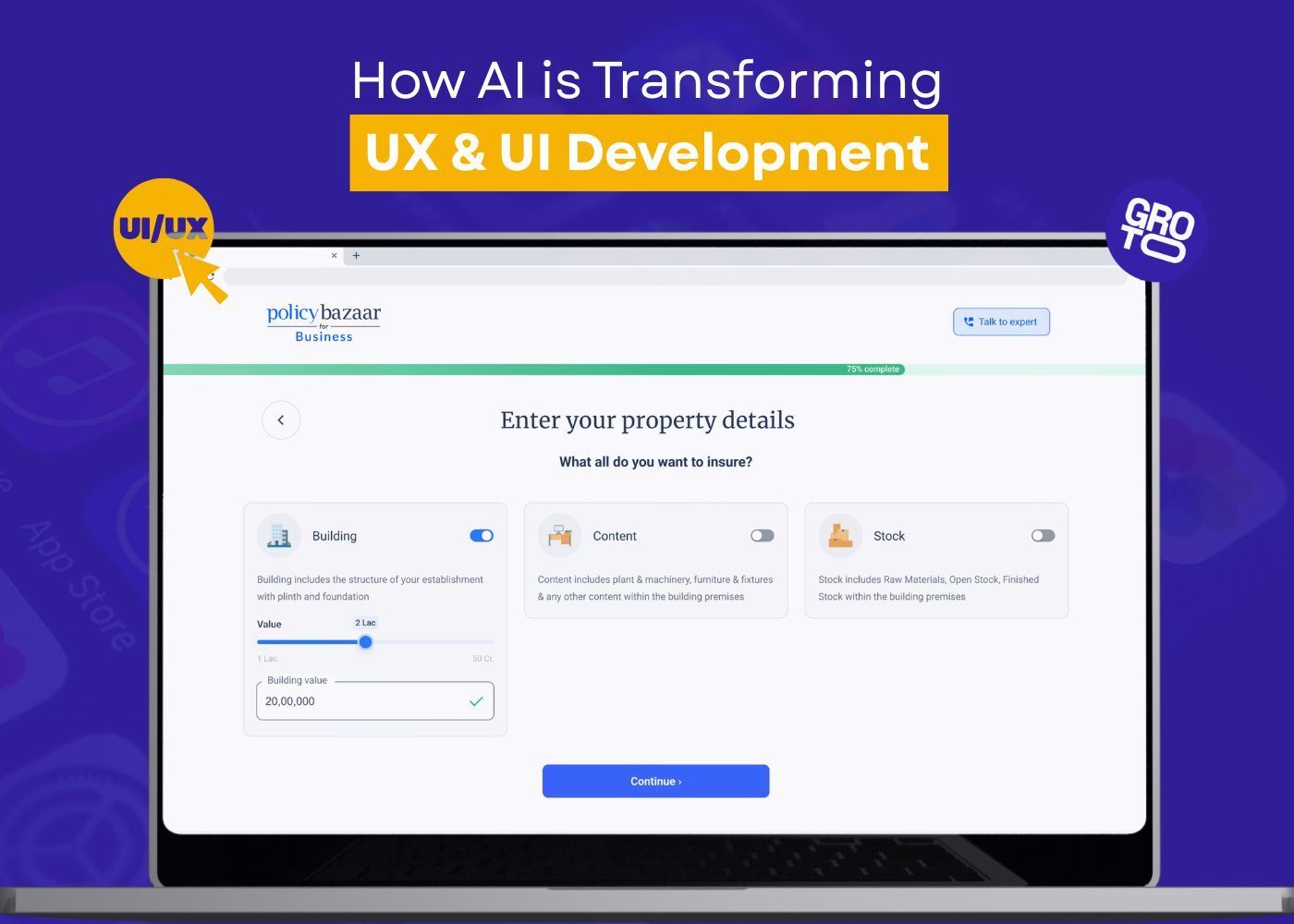
Case study: PolicyBazaar. We improved mobile and web UX for an insurance marketplace, reducing drop-offs and boosting sign-ups. Insurance flows are also a core Toronto industry, so the patterns carry over.

Best for: SaaS UX design, MVP design and product teams that want measurable results, not just mockups.

Want to know where your users are dropping off?

We’ll break down the exact moments users lose interest, and why.

Want to know where your users are dropping off?

We’ll break down the exact moments users lose interest, and why.

2. Akendi: Best for enterprise research and usability testing

Akéndi’s website featuring the headline “Human Insights, Intentional Experiences, Change That Matters,” with minimalist typography, cyan accents, and an illustration of people collaborating in a digital environment.

HQ: Toronto, with an office in Ottawa.

Akendi is one of Toronto's longest-running UX design agencies, with a research-heavy practice spanning UX strategy, user research, digital product design and usability testing. If your project lives or dies on rigorous, evidence-based research, think regulated industries or large enterprise platforms, Akendi's depth is a strong fit.

Best for: enterprises that need formal research and usability testing at scale.

3. Wavespace: Best for accessibility-first SaaS design

Wavespace’s UX design agency homepage featuring the headline “A global UX design agency for products that ship, convert, and scale,” alongside mobile app mockups and a clean white layout.

HQ: Toronto.

Wavespace is a UI/UX design and consulting agency crafting digital products for SaaS, AI, startups, enterprise and VC-backed teams. Its calling card is an accessibility-first, data-driven approach that targets WCAG 2.1 AA, increasingly non-negotiable for public-sector and enterprise buyers.

Best for: teams that need accessibility built in from day one.

4. Mindsea: Best for mobile and digital health products

Mindsea’s healthcare app development homepage featuring a teal hero section, a headline about building apps for real-world care, a circular photograph of healthcare professionals, and client logos.

HQ: Halifax, a Canadian studio rather than a Toronto one.

Mindsea brings a distinctly Canadian touch to mobile strategy, product design and development, with a clear emphasis on digital health. If your product is mobile-first, or you work where trust, privacy and clinical usability matter, its specialization is hard to match. Confirm early how it handles in-person sessions for Toronto teams.

Best for: mobile apps and healthtech products.

5. Nextbrain Technologies: Best for full-stack design and build

Nextbrain’s enterprise software development homepage featuring a minimalist pastel gradient background, centered typography, and prominent calls to action.

HQ: Toronto.

Nextbrain positions itself as a UI/UX agency offering mobile and web applications through an end-to-end UX and UI process. Teams that want design and development under one roof, with less handoff friction, should shortlist it.

Best for: clients who want design and engineering from a single vendor.

6. Interpix Design: Best for established, Toronto-rooted UX craft

Interpix’s web development agency homepage featuring a clean white layout, a headline highlighting over 30 years of experience, and a row of recent project cards.

HQ: Toronto.

Interpix has a long track record of user-centered design work. For companies that prefer a stable, senior team over a churn-heavy shop, its longevity is a signal worth weighing.

Best for: organizations prioritizing experience and continuity.

7. Makra Digital: Best for UX-led web design and conversion

M4R’s Toronto web design agency homepage featuring a dark background, centered white typography, a yellow call-to-action, and a flowing purple wave visualization.

HQ: Toronto.

Makra Digital builds responsive, intuitive websites engineered to retain and convert visitors. If your goal is a marketing site that turns traffic into pipeline, its conversion focus fits the brief. It is also a useful option if what you really need is a broader web design agency.

Best for: conversion-driven websites and landing experiences.

8. Roobinium: Best for web and web3 product design

Roobinium’s Toronto web design studio homepage featuring a panoramic city skyline, centered headline, and a dark portfolio section with service categories.

HQ: Toronto.

Roobinium is a UX/UI design and development company with expertise spanning web and web3. For teams building wallets, dApps or token-gated products, an agency that already knows those patterns saves months of ramp-up.

Best for: web3 and emerging-tech products.

9. ROSSUL: Best for enterprise UX and product modernization

Enterprise UX/UI design agency homepage featuring a minimalist black background, large gray and white typography, and an orange consultation button.

HQ: Toronto.

ROSSUL describes more than 15 years of enterprise UX and UI work across web, desktop and mobile, with a research-driven approach and a focus on modernizing complex products. It lists clients in industries such as finance, healthcare and SaaS. For enterprises updating legacy workflows, that experience is the draw.

Best for: enterprise teams modernizing complex, long-lived products.

10. Craft Innovations: Best for research-led fintech UX

Craft Innovations’ research and design agency homepage featuring a dark interface, centered typography, blue accent text, and a minimalist graphic illustrating its research, design, and growth process.

HQ: Toronto.

Craft Innovations is a research-first UX firm with a focus on financial services, including digital banking, lending and insurance. By its own account, it has completed more than 100 design and research projects in that space. If your product handles money and trust is the main risk, a specialist is worth a call. Toronto's finance sector makes this a natural local fit.

Best for: fintech and financial-services products that need deep research.

Beyond the ten: boutiques and global firms

Two other routes are worth knowing about.

Specialist boutiques and freelance collectives. Small Toronto studios take on focused work, such as a single flow, a design system or a discovery sprint. They offer good value for narrow scopes, with capacity and continuity as the trade-offs. Best for well-defined, limited-scope projects on a tighter budget.

Global agencies with a Toronto presence. International UX firms serve Toronto clients remotely or through local teams, usually at the top of the price range. If you are benchmarking against the wider US agency scene, compare New York, Los Angeles, Seattle and Chicago against the same criteria. Best for large enterprises that want a globally recognized partner and have the budget to match.

How much does a Toronto UX agency cost in 2026?

For the wider picture beyond Toronto, our web design agency pricing guide breaks down the full range.

Agencies rarely publish rate cards, so we used what is public. The table below uses figures from Craft Innovations' Canadian agency profiles. They are self-reported, unaudited, and the source does not state a currency, so treat them as directional.

Agency type

Example

Published minimum project

Published hourly rate

Web and brand-led studio

Brand Vision (Toronto)

$5,000

$100 to $149

Research-led UX

Craft Innovations (Toronto)

$10,000

$50 to $99

Enterprise UX

ROSSUL (Toronto)

$25,000

$100 to $149

UX plus engineering

Osedea (Montreal)

$50,000

$100 to $149

For a second reference point, most Toronto profiles on DesignRush list minimum budgets in either the $1,000 to $10,000 or the $10,000 to $25,000 band.

What moves the number:

  • Project complexity

  • Team seniority

  • Timeline urgency

  • Compliance requirements (accessibility, health, finance)

Budget-conscious teams sometimes weigh offshore hubs against these figures. Our Delhi design studios roundup is one such comparison. And if an agency quotes a firm price before understanding your scope, treat that as a flag, not a feature.

When to hire a UX agency vs. build an in-house team

This is less a budget question than a question of how continuous your design work is. One redesign is a project. A roadmap is a hire. Our breakdown of agency vs. in-house goes deeper. In short, an in-house designer is a fixed monthly cost that only pays off if the queue stays full, whether you hire in Toronto or in markets like the San Francisco Bay Area.

An agency wins when:

  • You need research, design and UI capability immediately

  • You want to avoid a 3-month hiring cycle

  • You are pre-Series A or earlier

In-house starts to make sense when:

  • You have a continuous, full-time pipeline of product work

  • You are typically post-Series B

  • You want design embedded in daily standups

A common middle path: use an agency to establish the UX foundation, design system and first validated flows, then hand over to in-house designers who maintain and extend them.

What a UX design engagement looks like

If you have never hired an agency, or you are still fuzzy on what a UX design agency does, the process can feel like a black box. Here is the shape of a healthy engagement:

  • Discovery. Stakeholder interviews, analytics and support-ticket review, and often direct user research, to define the real problem.

  • Structure. User flows, information architecture and low-fidelity wireframes that are cheap to change.

  • UI design. The visual layer, component library and interaction states.

  • Validation. Usability testing and iteration.

  • Handoff. Documented components, specs and design tokens your engineers can build from without guessing.

Notice that visuals come late. Weaker agencies jump straight to high-fidelity screens because they demo well, and your team falls in love with a look before the flow underneath is tested. When you evaluate a UX design agency in Toronto, ask them to walk you through this arc on a past project. If they cannot separate discovery from execution, that is a signal.

Red flags to watch for

Not every polished pitch hides a good process. Watch for agencies that:

  • Quote a fixed price and timeline before understanding your scope

  • Show a portfolio full of screenshots but no outcome metrics

  • Cannot tell you who will actually staff your project

  • Treat accessibility as an afterthought rather than a baseline

  • Position design as a purely aesthetic exercise disconnected from business goals

A great partner will push back on your assumptions. That friction is a feature, not a bug.

The 6 questions that reveal a real UX partner

Use these on your first call:

  1. What is your design process, and where does research fit? A clear answer mirrors how agencies build products that convert. Be wary of anyone who jumps straight to visuals.

  2. Which usability metrics do you track and report? Strong answers name task completion rate, error rate, time on task and satisfaction scores.

  3. Can you show outcome evidence, not just screenshots? You want before and after results. Knowing how to evaluate a portfolio helps you tell the two apart.

  4. Who exactly will work on my project? Understand the actual team, not just the partner who pitches you.

  5. How do you handle scope changes? Ask about deposits, milestones and change orders up front.

  6. What relevant industry experience do you have? Ask what they found hard on a similar project and how they solved it.

Conclusion: choose the partner, not just the portfolio

  • The best UX design agency in Toronto for you is not the one with the flashiest reel. It is the one whose process, metrics and industry experience map to your product and stage.

  • Pressure-test every shortlisted agency on four things: research-led, outcome-measured, engineering-aware and transparent on price.

  • Decide early whether you need people in the room. If you do, start with the Toronto-based studios above. If remote works, widen the list.

  • If you are building a SaaS product or MVP and want one of the UX design companies for SaaS that ties design to real results, book a discovery call with us. We will walk through your product, your goals and whether we are the right fit. No pressure, no jargon.

Choosing a UX partner in Toronto is a high-stakes call. We compared 10 agencies on research depth, outcomes, accessibility and price, and flag where each fits best, so you can shortlist with confidence.

An honest 2026 shortlist of Toronto UX agencies, with pricing, red flags and hiring questions.

TL;DR

  • This shortlist compares 10 agencies by headquarters, specialty and fit, across SaaS, enterprise research, accessibility, digital health, fintech and web3.

  • We rank Groto first for outcome-led SaaS work. We are not a Toronto studio. We work with Toronto teams remotely, and we say so in our entry.

  • Published Canadian agency rates run from about $50 to $199 an hour, with minimum projects from $5,000 to $50,000, according to Craft Innovations' published profiles.

  • Use the 6 questions near the end on your first call. They separate a real design partner from an expensive vendor.

A UX design agency in Toronto is the partner most SaaS founders and product teams hire to turn research, user flows and interface design into a product people want to use. The market is crowded, from boutique studios to global firms. The real work is separating agencies that ship measurable outcomes from agencies that only ship screens.

The wrong choice costs more than a design fee. It costs a launch window and a round of engineering rework. So we built a criteria-first shortlist, followed by costs, a decision framework and the questions that expose a weak partner.

One note on bias. We are Groto, and we are on this list. We are also not based in Toronto. We held every agency to the same criteria, and we flag where a local studio is the better pick.

The shortlist at a glance

Grid of ten company logos, including Groto, Akéndi, Wavespace, Mindsea, Nextbrain, Interpix, Craft Innovations, M4R, and two additional brand marks, displayed in rounded cards against a purple grid background.

#

Agency

H

Best for

1

Groto

India (remote)

SaaS and AI product teams

2

Akendi

Toronto

Enterprise research and usability testing

3

Wavespace

Toronto

Accessibility-first SaaS design

4

Mindsea

Halifax

Mobile and digital health

5

Nextbrain Technologies

Toronto

Design and build under one roof

6

Interpix Design

Toronto

Established, senior UX craft

7

Makra Digital

Toronto

UX-led web design and conversion

8

Roobinium

Toronto

Web and web3 products

9

ROSSUL

Toronto

Enterprise UX and modernization

10

Craft Innovations

Toronto

Research-led fintech UX

How we chose these agencies

A strong agency should show five things:

  • Research-led process. Not just polished screens.

  • Measurable outcomes. Task completion, conversion and retention, not "we redesigned it."

  • Relevant industry experience. SaaS, fintech, healthtech, marketplaces.

  • Engineering-aware design. Work that survives contact with real developers.

  • Transparent pricing and scope.

This matters because a confusing onboarding flow does not throw an error. It shows up as lower activation three months later. Usability research has long held that fixing problems during design is far cheaper than fixing them after launch, so the right agency surfaces problems before your engineers build them.

If you want the wider buying checklist, our guide on how to choose the right agency covers it step by step.

The Toronto market in 2026

Toronto combines a large enterprise base in finance, insurance and telecom with a mature startup ecosystem. That mix produces three kinds of agency: research-heavy enterprise firms, product studios for startups and SaaS, and web-led shops focused on conversion.

A few things have shifted going into 2026:

  • AI now sits inside the brief. Buyers ask how an agency uses AI in research, prototyping and design systems, and expect it to show up in timelines and price.

  • AI product UX is its own skill. Copilots and agents need trust cues, error states and review steps that classic SaaS patterns do not cover.

  • Accessibility is a purchasing requirement. Enterprise and public-sector buyers screen for it early.

  • Language can matter. Products serving Quebec often need French support planned from the start.

Hiring locally still has real benefits:

  • Time-zone alignment for daily collaboration, not overnight handoffs.

  • Easier in-person workshops for discovery and stakeholder alignment.

  • Familiarity with Canadian accessibility and privacy expectations that offshore teams sometimes miss.

The trade-off is cost. A local agency usually costs more than a distributed team and less than a US coastal firm, such as those in the San Francisco Bay Area. Discovery workshops benefit from proximity. Execution usually does not. Hiring a UX design agency in Toronto makes the most sense when workshops and stakeholder access are central to the project.

The 10 best UX design agencies in Toronto

1. Groto: Best for SaaS and AI product teams that can work remotely

Groto’s AI-first UX design agency homepage featuring oversized white typography, vibrant blue and pink particle visuals, and a dark, immersive hero section.

HQ: India, working remotely with product teams.

We lead this list because we do what most agencies only claim to do: tie design decisions to product outcomes. Our work in SaaS UX design pairs user research and data with high-craft UI, so what lands in your codebase is validated, accessible and ready to convert. Our UI/UX design services treat discovery and execution as separate phases, so you never pay for polish before the problem is understood.

To be direct: if you need your designers physically in Toronto, pick one of the studios below. If remote works for you, we offer startup speed with enterprise rigor.

Known for:

  • Tying design decisions to product outcomes, not just visuals

  • Separating discovery and execution into distinct phases

  • Working with SaaS companies, startups and VC-backed teams

Case study: PolicyBazaar. We improved mobile and web UX for an insurance marketplace, reducing drop-offs and boosting sign-ups. Insurance flows are also a core Toronto industry, so the patterns carry over.

Best for: SaaS UX design, MVP design and product teams that want measurable results, not just mockups.

Want to know where your users are dropping off?

We’ll break down the exact moments users lose interest, and why.

2. Akendi: Best for enterprise research and usability testing

Akéndi’s website featuring the headline “Human Insights, Intentional Experiences, Change That Matters,” with minimalist typography, cyan accents, and an illustration of people collaborating in a digital environment.

HQ: Toronto, with an office in Ottawa.

Akendi is one of Toronto's longest-running UX design agencies, with a research-heavy practice spanning UX strategy, user research, digital product design and usability testing. If your project lives or dies on rigorous, evidence-based research, think regulated industries or large enterprise platforms, Akendi's depth is a strong fit.

Best for: enterprises that need formal research and usability testing at scale.

3. Wavespace: Best for accessibility-first SaaS design

Wavespace’s UX design agency homepage featuring the headline “A global UX design agency for products that ship, convert, and scale,” alongside mobile app mockups and a clean white layout.

HQ: Toronto.

Wavespace is a UI/UX design and consulting agency crafting digital products for SaaS, AI, startups, enterprise and VC-backed teams. Its calling card is an accessibility-first, data-driven approach that targets WCAG 2.1 AA, increasingly non-negotiable for public-sector and enterprise buyers.

Best for: teams that need accessibility built in from day one.

4. Mindsea: Best for mobile and digital health products

Mindsea’s healthcare app development homepage featuring a teal hero section, a headline about building apps for real-world care, a circular photograph of healthcare professionals, and client logos.

HQ: Halifax, a Canadian studio rather than a Toronto one.

Mindsea brings a distinctly Canadian touch to mobile strategy, product design and development, with a clear emphasis on digital health. If your product is mobile-first, or you work where trust, privacy and clinical usability matter, its specialization is hard to match. Confirm early how it handles in-person sessions for Toronto teams.

Best for: mobile apps and healthtech products.

5. Nextbrain Technologies: Best for full-stack design and build

Nextbrain’s enterprise software development homepage featuring a minimalist pastel gradient background, centered typography, and prominent calls to action.

HQ: Toronto.

Nextbrain positions itself as a UI/UX agency offering mobile and web applications through an end-to-end UX and UI process. Teams that want design and development under one roof, with less handoff friction, should shortlist it.

Best for: clients who want design and engineering from a single vendor.

6. Interpix Design: Best for established, Toronto-rooted UX craft

Interpix’s web development agency homepage featuring a clean white layout, a headline highlighting over 30 years of experience, and a row of recent project cards.

HQ: Toronto.

Interpix has a long track record of user-centered design work. For companies that prefer a stable, senior team over a churn-heavy shop, its longevity is a signal worth weighing.

Best for: organizations prioritizing experience and continuity.

7. Makra Digital: Best for UX-led web design and conversion

M4R’s Toronto web design agency homepage featuring a dark background, centered white typography, a yellow call-to-action, and a flowing purple wave visualization.

HQ: Toronto.

Makra Digital builds responsive, intuitive websites engineered to retain and convert visitors. If your goal is a marketing site that turns traffic into pipeline, its conversion focus fits the brief. It is also a useful option if what you really need is a broader web design agency.

Best for: conversion-driven websites and landing experiences.

8. Roobinium: Best for web and web3 product design

Roobinium’s Toronto web design studio homepage featuring a panoramic city skyline, centered headline, and a dark portfolio section with service categories.

HQ: Toronto.

Roobinium is a UX/UI design and development company with expertise spanning web and web3. For teams building wallets, dApps or token-gated products, an agency that already knows those patterns saves months of ramp-up.

Best for: web3 and emerging-tech products.

9. ROSSUL: Best for enterprise UX and product modernization

Enterprise UX/UI design agency homepage featuring a minimalist black background, large gray and white typography, and an orange consultation button.

HQ: Toronto.

ROSSUL describes more than 15 years of enterprise UX and UI work across web, desktop and mobile, with a research-driven approach and a focus on modernizing complex products. It lists clients in industries such as finance, healthcare and SaaS. For enterprises updating legacy workflows, that experience is the draw.

Best for: enterprise teams modernizing complex, long-lived products.

10. Craft Innovations: Best for research-led fintech UX

Craft Innovations’ research and design agency homepage featuring a dark interface, centered typography, blue accent text, and a minimalist graphic illustrating its research, design, and growth process.

HQ: Toronto.

Craft Innovations is a research-first UX firm with a focus on financial services, including digital banking, lending and insurance. By its own account, it has completed more than 100 design and research projects in that space. If your product handles money and trust is the main risk, a specialist is worth a call. Toronto's finance sector makes this a natural local fit.

Best for: fintech and financial-services products that need deep research.

Beyond the ten: boutiques and global firms

Two other routes are worth knowing about.

Specialist boutiques and freelance collectives. Small Toronto studios take on focused work, such as a single flow, a design system or a discovery sprint. They offer good value for narrow scopes, with capacity and continuity as the trade-offs. Best for well-defined, limited-scope projects on a tighter budget.

Global agencies with a Toronto presence. International UX firms serve Toronto clients remotely or through local teams, usually at the top of the price range. If you are benchmarking against the wider US agency scene, compare New York, Los Angeles, Seattle and Chicago against the same criteria. Best for large enterprises that want a globally recognized partner and have the budget to match.

How much does a Toronto UX agency cost in 2026?

For the wider picture beyond Toronto, our web design agency pricing guide breaks down the full range.

Agencies rarely publish rate cards, so we used what is public. The table below uses figures from Craft Innovations' Canadian agency profiles. They are self-reported, unaudited, and the source does not state a currency, so treat them as directional.

Agency type

Example

Published minimum project

Published hourly rate

Web and brand-led studio

Brand Vision (Toronto)

$5,000

$100 to $149

Research-led UX

Craft Innovations (Toronto)

$10,000

$50 to $99

Enterprise UX

ROSSUL (Toronto)

$25,000

$100 to $149

UX plus engineering

Osedea (Montreal)

$50,000

$100 to $149

For a second reference point, most Toronto profiles on DesignRush list minimum budgets in either the $1,000 to $10,000 or the $10,000 to $25,000 band.

What moves the number:

  • Project complexity

  • Team seniority

  • Timeline urgency

  • Compliance requirements (accessibility, health, finance)

Budget-conscious teams sometimes weigh offshore hubs against these figures. Our Delhi design studios roundup is one such comparison. And if an agency quotes a firm price before understanding your scope, treat that as a flag, not a feature.

When to hire a UX agency vs. build an in-house team

This is less a budget question than a question of how continuous your design work is. One redesign is a project. A roadmap is a hire. Our breakdown of agency vs. in-house goes deeper. In short, an in-house designer is a fixed monthly cost that only pays off if the queue stays full, whether you hire in Toronto or in markets like the San Francisco Bay Area.

An agency wins when:

  • You need research, design and UI capability immediately

  • You want to avoid a 3-month hiring cycle

  • You are pre-Series A or earlier

In-house starts to make sense when:

  • You have a continuous, full-time pipeline of product work

  • You are typically post-Series B

  • You want design embedded in daily standups

A common middle path: use an agency to establish the UX foundation, design system and first validated flows, then hand over to in-house designers who maintain and extend them.

What a UX design engagement looks like

If you have never hired an agency, or you are still fuzzy on what a UX design agency does, the process can feel like a black box. Here is the shape of a healthy engagement:

  • Discovery. Stakeholder interviews, analytics and support-ticket review, and often direct user research, to define the real problem.

  • Structure. User flows, information architecture and low-fidelity wireframes that are cheap to change.

  • UI design. The visual layer, component library and interaction states.

  • Validation. Usability testing and iteration.

  • Handoff. Documented components, specs and design tokens your engineers can build from without guessing.

Notice that visuals come late. Weaker agencies jump straight to high-fidelity screens because they demo well, and your team falls in love with a look before the flow underneath is tested. When you evaluate a UX design agency in Toronto, ask them to walk you through this arc on a past project. If they cannot separate discovery from execution, that is a signal.

Red flags to watch for

Not every polished pitch hides a good process. Watch for agencies that:

  • Quote a fixed price and timeline before understanding your scope

  • Show a portfolio full of screenshots but no outcome metrics

  • Cannot tell you who will actually staff your project

  • Treat accessibility as an afterthought rather than a baseline

  • Position design as a purely aesthetic exercise disconnected from business goals

A great partner will push back on your assumptions. That friction is a feature, not a bug.

The 6 questions that reveal a real UX partner

Use these on your first call:

  1. What is your design process, and where does research fit? A clear answer mirrors how agencies build products that convert. Be wary of anyone who jumps straight to visuals.

  2. Which usability metrics do you track and report? Strong answers name task completion rate, error rate, time on task and satisfaction scores.

  3. Can you show outcome evidence, not just screenshots? You want before and after results. Knowing how to evaluate a portfolio helps you tell the two apart.

  4. Who exactly will work on my project? Understand the actual team, not just the partner who pitches you.

  5. How do you handle scope changes? Ask about deposits, milestones and change orders up front.

  6. What relevant industry experience do you have? Ask what they found hard on a similar project and how they solved it.

Conclusion: choose the partner, not just the portfolio

  • The best UX design agency in Toronto for you is not the one with the flashiest reel. It is the one whose process, metrics and industry experience map to your product and stage.

  • Pressure-test every shortlisted agency on four things: research-led, outcome-measured, engineering-aware and transparent on price.

  • Decide early whether you need people in the room. If you do, start with the Toronto-based studios above. If remote works, widen the list.

  • If you are building a SaaS product or MVP and want one of the UX design companies for SaaS that ties design to real results, book a discovery call with us. We will walk through your product, your goals and whether we are the right fit. No pressure, no jargon.

Have a project in mind?

Let’s talk through your idea and see what makes sense.

Harpreet Singh

Founder at Groto

Have a project in mind?

Let’s talk through your idea and see what makes sense.

Harpreet Singh

Founder at Groto

FAQ

Everything you were going to ask (and a few things you didn’t know to)

Are Toronto agency quotes in CAD or USD, and what else should I check?

Ask for the currency in writing, because published figures often do not state it. Also confirm whether sales tax is included, how many revision rounds are covered, and who is on the team. Quotes are only comparable once scope, seniority and testing are normalized.

Do I need to meet AODA accessibility rules?

Ontario's accessibility law requires public websites of larger organizations to meet WCAG 2.0 Level AA, generally those with 50 or more employees. Many teams aim higher, at WCAG 2.1 AA. Check your own obligations with legal counsel, and ask agencies how they test.

How can I test an agency before signing a large contract?

Start with a paid, fixed-scope engagement such as a discovery sprint or a UX audit of one flow. You see their process, communication and quality before committing to a full redesign. Treat the output as the real audition.
Can a team outside Toronto hire a Toronto UX agency?

Yes. Most agencies work with distributed clients using async workshops, recorded research sessions and shared design files. Check overlap in working hours and how they run research with your users in your market.

Does Groto offer flexible pricing for smaller teams?

Yes. We run a subscription model instead of one-off project quotes, with plans that scale from part-time to full-time coverage. Billing options and trial terms change, so current details are always live on our pricing page

Who owns the design files at the end of a project?

This is set by your contract, so settle it before work starts. Many agreements transfer ownership of final deliverables on full payment, and some agencies keep rights to reusable components. Have counsel review the intellectual property clause.

Are Toronto agency quotes in CAD or USD, and what else should I check?

Ask for the currency in writing, because published figures often do not state it. Also confirm whether sales tax is included, how many revision rounds are covered, and who is on the team. Quotes are only comparable once scope, seniority and testing are normalized.

Do I need to meet AODA accessibility rules?

Ontario's accessibility law requires public websites of larger organizations to meet WCAG 2.0 Level AA, generally those with 50 or more employees. Many teams aim higher, at WCAG 2.1 AA. Check your own obligations with legal counsel, and ask agencies how they test.

How can I test an agency before signing a large contract?

Start with a paid, fixed-scope engagement such as a discovery sprint or a UX audit of one flow. You see their process, communication and quality before committing to a full redesign. Treat the output as the real audition.
Can a team outside Toronto hire a Toronto UX agency?

Yes. Most agencies work with distributed clients using async workshops, recorded research sessions and shared design files. Check overlap in working hours and how they run research with your users in your market.
Does Groto offer flexible pricing for smaller teams?

Yes. We run a subscription model instead of one-off project quotes, with plans that scale from part-time to full-time coverage. Billing options and trial terms change, so current details are always live on our pricing page

Who owns the design files at the end of a project?

This is set by your contract, so settle it before work starts. Many agreements transfer ownership of final deliverables on full payment, and some agencies keep rights to reusable components. Have counsel review the intellectual property clause.

More Articles

Extreme close-up black and white photograph of a human eye

Let’s bring your vision to life

Tell us what's on your mind? We'll hit you back in 24 hours. No fluff, no delays - just a solid vision to bring your idea to life.

Profile portrait of a man in a white shirt against a light background

Harpreet Singh

Founder and Creative Director

Get in Touch