Interim Design Agency: Covering a Design Lead Search the Right Way

Interim Design Agency: Covering a Design Lead Search the Right Way

A practical guide to when an interim design agency should cover a design-lead search, how it compares to interim and fractional leaders, and how to hand off cleanly.

Interim Design Agency: Covering a Design Lead Search the Right Way

Interim Design Agency: Covering a Design Lead Search the Right Way

A practical guide to when an interim design agency should cover a design-lead search, how it compares to interim and fractional leaders, and how to hand off cleanly.

Your design lead just left and the search will take months. This guide shows when an interim design agency fits, when an interim or fractional leader fits better, and how to hand off cleanly.

When to bring in an interim design agency while you search for a design lead.

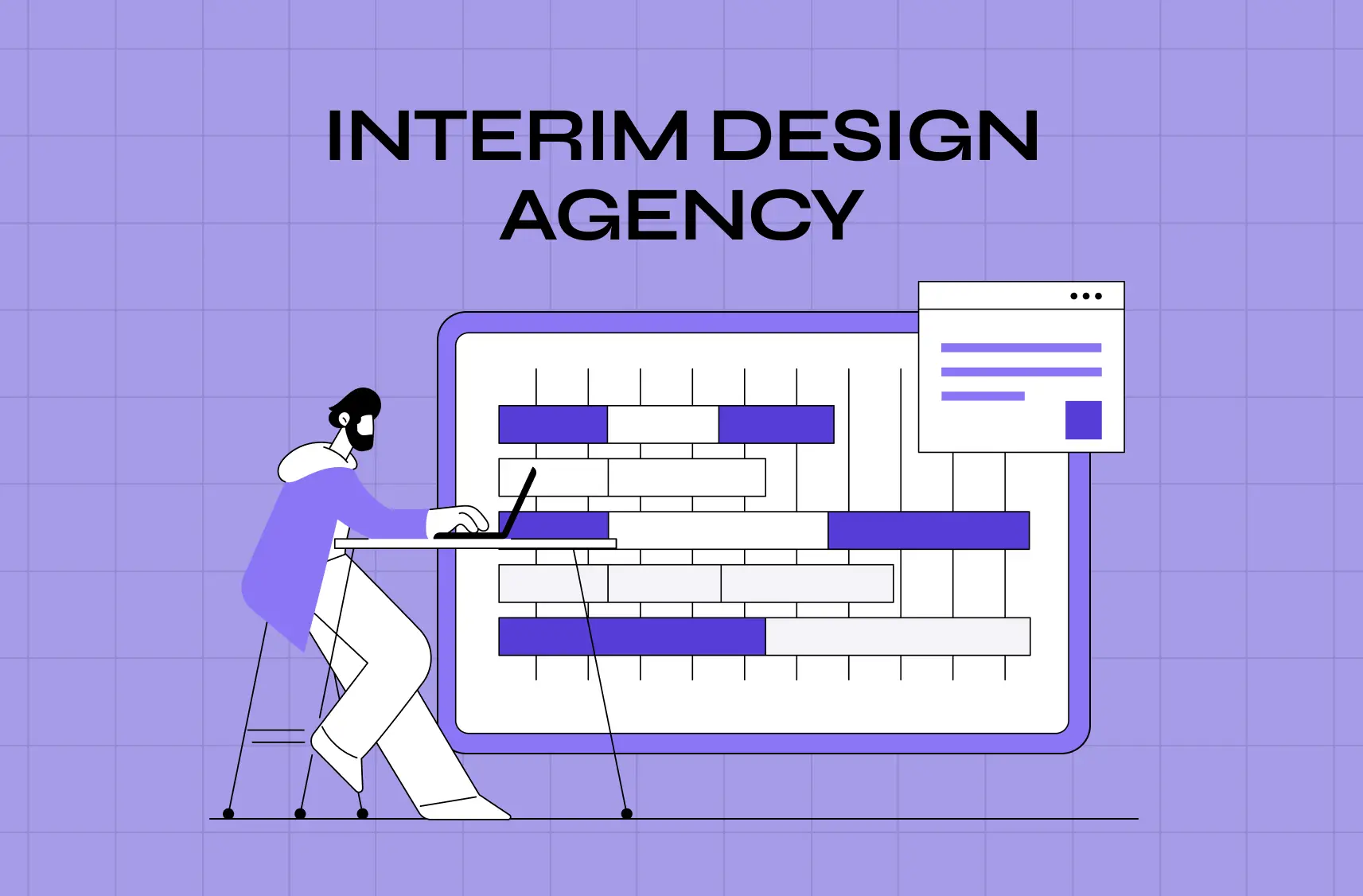
Illustration of a designer planning a project using a large digital timeline with horizontal task bars and a floating browser window on a purple background.

TL;DR

  • A design-lead gap breaks two things at once: team management and design direction. Both stall the roadmap.

  • An interim design agency covers the work and direction half, keeping output shipping at quality while you run a proper search. It does not manage your people or own org strategy.

  • Agency cover fits best when your internal team is small or nonexistent, the roadmap cannot wait, or you need senior direction before a full-time executive makes sense.

  • Use the Cover Fit frame and the five-question scorecard below to choose between an agency, an interim leader and a fractional leader.

  • Set it up as a scoped bridge with written ownership, continuity documentation and a planned taper, so the permanent hire inherits a healthy function.

Losing a design lead is one of the more disruptive gaps a product team can face, and it is exactly where an interim design agency earns its place. A design-lead vacancy stalls two things at once: the people who need managing and the work that needs direction. Bringing in an agency is a specific, well-scoped move, not a generic stopgap.

Your Head of Design has given notice. The roadmap does not care. You have a product to ship, a design team (or no design team) that needs direction, and a senior search that takes months: one marketplace's published comparison lists three to six months to hire a full-time Head of Product Design. So you face a choice most leaders do not plan for until it is urgent. Do you let design coast, rush the hire, bring in an interim or fractional leader, or hire an agency to cover the gap?

This guide is about that last option, and just as much about when not to use it. It is written for founders, CTOs and PMs facing a design-leadership gap. We cover why the gap is riskier than it looks, what agency cover provides and what it does not, how it compares on scope and cost, a scorecard to pick your cover, how to set it up, and how to hand off cleanly.

Why a design-leadership gap is more dangerous than it looks

Infographic titled “From Design-Leadership Gap to Protected Roadmap,” showing layered colored platforms representing team drift, work drift, roadmap delays, pressure, and structured hiring.

A design leader does two different jobs at once, and when they leave, both stop at the same time. It is tempting to treat the vacancy as a line item to backfill, but the damage compounds while the seat is empty.

They were holding together two distinct things:

  • Leadership: managing the team's day-to-day work, sprints, careers and morale, aligning with stakeholders, and owning design strategy.

  • Design direction and execution: setting the quality bar, making the hard design calls, and making sure good work actually ships.

In our experience, overlap between an outgoing and an incoming leader is rare, so the gap is usually real. The team drifts without management, the work drifts without direction, and the roadmap slows exactly when you can least afford it.

That slowdown creates the real trap: pressure. A stalled roadmap makes the vacancy hurt every week, which pushes you to hire fast rather than well. A design leader is a high-stakes, hard-to-reverse hire, and rushing it because the pain is acute is how companies end up re-running the same search a year later.

Cover, in whatever form, exists to remove that pressure. With the roadmap protected, your search team can interview thoroughly and wait for the right fit, because nothing depends on the hire closing next week.

Want to know where your users are dropping off?

We’ll break down the exact moments users lose interest, and why.

Want to know where your users are dropping off?

We’ll break down the exact moments users lose interest, and why.

What an interim design agency covers (and what it does not)

Hiring an interim design agency to cover a design-lead search means bringing in an outside team that plugs into your design process to keep work shipping at quality. It supplies execution capacity and senior direction during the gap. It does not mean outsourcing the leadership of your internal team.

What an agency covers:

  • Taking the roadmap and keeping it moving with quality output.

  • Senior designers setting and holding the bar so standards do not slip while the seat is empty.

  • Scaling capacity up or down as the gap's needs change.

What an agency generally does not do:

  • Manage your internal designers day to day, including careers, performance and growth.

  • Own your long-term org strategy.

  • Act as the internal figure the team reports to.

Marketplaces that sell interim and fractional leaders often describe agencies as output-focused, with limited strategic input and ownership scoped to deliverables (see Go Fractional's comparison). That is a fair description of project-based work. A well-scoped bridge is different: the agency owns design direction and the quality bar on the agreed roadmap, while you keep team management and the search.

To choose well, we use a simple lens we call the Cover Fit frame. Any design-lead gap is some mix of three holes:

  • Work gap: output is slowing, quality is slipping, and nobody holds the bar. Best cover: an agency.

  • Team gap: designers are unmanaged, careers stall, and nobody steers the function day to day. Best cover: an interim design leader (full-time, temporary).

  • Direction gap: the team mostly runs itself but lacks senior strategic judgment. Best cover: a fractional design leader (part-time and ongoing, typically one to three days a week).

Most real gaps mix all three. The question is which hole is biggest right now.

When agency cover makes sense

Infographic titled “When Does Agency Cover Make Sense?” presenting five colorful geometric blocks representing different scenarios for temporary design leadership and agency support.

Agency cover makes sense when the gap is mostly about keeping design work shipping at quality. These are the strong-fit situations:

  • Your roadmap cannot wait the length of a proper search. If a critical design leader resigns and the product cannot pause, an agency keeps momentum with a whole team ready to ship. A useful trigger: if the search is projected past six to eight weeks and the roadmap is visibly slowing (features not shipping, hard design calls going unmade, quality slipping), bring in cover rather than absorb the drift.

  • The gap is primarily execution, not team management. If you have a small design team, or none, there is little internal team to manage. You need capacity and direction. We built PathwaysX's AI-powered B2B hiring platform from scratch, which is the same shape of problem: no inherited system, so the job is to set the bar and direction while you hire.

  • You want optionality and a clean exit. An agency scales with your needs and ends when the permanent leader is in place, similar in spirit to the flexibility of the best design subscription services. No severance, no reorg, no awkward question about what to do with the interim person afterwards.

  • You are not yet sure what permanent role you need. A departure is a chance to rethink the role: a hands-on design director, a people-first design manager, a VP? Cover buys you time to decide without a stalled roadmap forcing it.

  • You need senior direction now, but a full-time executive is premature. For an earlier-stage company, an executive salary may be more than the stage warrants, yet the work still needs senior judgment today. This is the same gap a UX design agency for startups often fills before a founding designer is hired.

This is a common pattern for SaaS and AI-first product teams still finding their footing on org design. It matters most on products where several needs compete, like our redesign of Barista into a PR-first AI platform, because that is where an unowned quality bar slips first.

Signals worth watching for:

  • Work is shipping without a consistent quality bar, and no one owns the call on what is good enough.

  • Several designers or contractors are being onboarded at once with no one to set standards.

  • A launch is already behind schedule and needs experienced hands to triage it.

  • Your founder or exec team is focused on fundraising or strategy, and no one is in the day-to-day work.

In all of these, the thing at risk is the work, and an agency is built to protect exactly that.

When an agency is not the right cover

An agency is the wrong cover when the gap is primarily about leadership. Saying so is what makes the recommendation trustworthy when it does apply.

  • You have an established internal team. This is often the case at the scale the best enterprise UX design agencies typically serve. Several designers need managing, mentoring and unblocking, with someone accountable for their growth and morale. You need a person in the seat: an interim leader or a fractional one.

  • The role depends on deep institutional context. Internal relationships, history and political knowledge only accrue to an embedded leader over time.

  • Leadership hours alone are what you need. For leadership-only coverage, one person's hours are usually cheaper than a team's output, which is why interim and fractional leaders exist as separate options.

  • Management is exactly the gap. A fractional leader usually will not run day-to-day projects, sprints and careers. If that is your gap, lean interim rather than fractional.

Agency, interim or fractional: what each owns and costs

Published numbers for design leadership are scarce, so here are the benchmarks we could verify. They are marketplace and recruiter figures, not quotes, and they will not match every engagement.

Cover

What it owns

Typical shape

Published benchmark

Agency

Execution, direction and the quality bar on the roadmap

Scoped retainer with a team ready to ship

Marketplace comparison lists 1 to 4 weeks to start; pricing is scoped per engagement

Interim leader

Team management plus direction

Full-time and temporary; a recruiter says typically 3 to 6 months

From $18,400 a month full-time (Go Fractional); UK day rate of £550 to £700 (Intelligent People)

Fractional leader

Strategic judgment and oversight


Part-time, ongoing

From $5,000 a month, about 28 hours at a $176 hourly average (Go Fractional)

Agency retainers vary with team size and scope, so ask for a monthly rate against defined outputs and a defined end. For how agency work is priced more broadly, see how much it costs to redesign a website.

These options are not mutually exclusive. A strong setup is an agency keeping execution moving while a fractional leader provides light-touch strategic oversight, covering two holes without a full-time commitment to either.

A five-question scorecard to pick your cover

Answer yes or no, then tally the tags.

  1. Will the roadmap slip in the next eight weeks without senior design direction? (Work)

  2. Do you have two or fewer designers in-house, or none? (Work)

  3. Do designers need someone running reviews, one-to-ones and careers every week? (Team)

  4. Is the team otherwise running well, missing mainly senior strategic judgment a few days a week? (Direction)

  5. Are you still deciding what the permanent role should be? (Work)

How to read your score:

  • Mostly Work: an agency is your best cover.

  • Team leads: an interim design leader fits better.

  • Direction leads: a fractional leader is the efficient choice.

  • Work and Direction both score: consider an agency plus a fractional leader.

How to set up agency cover as a bridge

Infographic titled “What Terms Should Structure Agency Cover as a Bridge?” featuring four colorful directional arrows representing ownership split, continuity artifacts, strategy anchor, and end condition.

Cover done carelessly can complicate the very search it is meant to protect, so structure it deliberately. These are the terms we would write down before day one:

  • Ownership split. The agency owns keeping the roadmap moving, design direction and quality. The company retains team management, final strategic calls and the search itself. Writing it down prevents overreach and prevents gaps where each side assumes the other has it covered.

  • End condition. Scope the engagement as a bridge through the search plus a handoff window, with the same clear-timeline discipline as a website redesign timeline. It should end because a permanent leader is in place, not drift into a permanent dependency.

  • Continuity artifacts. Require documented design decisions, an up-to-date design system, and a record of in-flight work and rationale. The worst outcome of any interim arrangement is a permanent leader inheriting an undocumented black box.

  • Strategy anchor. Ground the work in UX strategy rather than pure output. A good agency does not just ship screens; it documents the reasoning behind decisions, and that is a large part of what you are paying for. Set the expectation at the start, not at the handoff.

Handing off to the permanent hire

The handoff is where interim cover succeeds or fails in the eyes of the person who matters most: the leader you worked so hard to hire. Plan it from day one:

  • Have the agency document decisions and in-flight work throughout, not just at the end.

  • Transition deliberately when the permanent leader starts, rather than with an abrupt cutover.

  • Let the agency taper rather than vanish, staying on for capacity while the new leader finds their feet and stepping back as they take hold.

Because the continuity artifacts have been kept all along, the handover is structured rather than an archaeology project. The new leader gets the decisions, the rationale, the system and the state of every in-flight initiative, and can lead from strength instead of firefighting for a month.

What changes in 2026

Three shifts affect how you should brief and judge cover this year:

  • AI fluency is part of the bar. In our experience, you should expect an agency to say how AI tools are used in design and review, and what stays human-checked.

  • Continuity now includes AI-assisted workflows. Alongside decisions and components, document how AI tools are used so the permanent leader inherits the practice, not just the files.

  • Buyers arrive with benchmarks. Interim and fractional leadership now come with published rates, so an interim design agency is compared on scope clarity and ownership, not only price.

Common mistakes when using an agency to cover a design gap

  • Mismatching the cover to the gap. Using an agency for a leadership gap, or hiring a single interim manager when the real need was execution capacity.

  • Not scoping an end. Cover either hardens into an accidental permanent arrangement or gets cut before the new leader is ready.

  • Skipping documentation. The permanent hire inherits a mess and the continuity you paid for evaporates.

  • Rushing the permanent hire anyway. This defeats the purpose. Cover exists to let you hire well.

  • Treating cover and the search as either/or. The agency protects the search by removing the pressure that causes bad hires.

Conclusion

  • A design-leadership gap does two kinds of damage at once: the team drifts and the work stalls, and the pressure pushes companies into rushed mis-hires.

  • An interim design agency is the right cover when the gap is mostly about keeping work shipping at quality: a small or nonexistent team, a roadmap that cannot wait, and a need for senior direction without a premature executive commitment.

  • It is the wrong cover when the real gap is managing an established team. That is a job for an interim or fractional leader in the seat.

  • Match the cover to the hole you have, scope it as a bridge, and plan the handoff from day one.

  • If your design lead has moved on and you need design shipping at quality while you run a proper search, book a discovery call with Groto. We are an AI-first design studio working with SaaS and AI product teams, and we will tell you honestly whether an agency, an interim leader or a fractional leader fits your gap.

Your design lead just left and the search will take months. This guide shows when an interim design agency fits, when an interim or fractional leader fits better, and how to hand off cleanly.

When to bring in an interim design agency while you search for a design lead.

Illustration of a designer planning a project using a large digital timeline with horizontal task bars and a floating browser window on a purple background.

TL;DR

  • A design-lead gap breaks two things at once: team management and design direction. Both stall the roadmap.

  • An interim design agency covers the work and direction half, keeping output shipping at quality while you run a proper search. It does not manage your people or own org strategy.

  • Agency cover fits best when your internal team is small or nonexistent, the roadmap cannot wait, or you need senior direction before a full-time executive makes sense.

  • Use the Cover Fit frame and the five-question scorecard below to choose between an agency, an interim leader and a fractional leader.

  • Set it up as a scoped bridge with written ownership, continuity documentation and a planned taper, so the permanent hire inherits a healthy function.

Losing a design lead is one of the more disruptive gaps a product team can face, and it is exactly where an interim design agency earns its place. A design-lead vacancy stalls two things at once: the people who need managing and the work that needs direction. Bringing in an agency is a specific, well-scoped move, not a generic stopgap.

Your Head of Design has given notice. The roadmap does not care. You have a product to ship, a design team (or no design team) that needs direction, and a senior search that takes months: one marketplace's published comparison lists three to six months to hire a full-time Head of Product Design. So you face a choice most leaders do not plan for until it is urgent. Do you let design coast, rush the hire, bring in an interim or fractional leader, or hire an agency to cover the gap?

This guide is about that last option, and just as much about when not to use it. It is written for founders, CTOs and PMs facing a design-leadership gap. We cover why the gap is riskier than it looks, what agency cover provides and what it does not, how it compares on scope and cost, a scorecard to pick your cover, how to set it up, and how to hand off cleanly.

Why a design-leadership gap is more dangerous than it looks

Infographic titled “From Design-Leadership Gap to Protected Roadmap,” showing layered colored platforms representing team drift, work drift, roadmap delays, pressure, and structured hiring.

A design leader does two different jobs at once, and when they leave, both stop at the same time. It is tempting to treat the vacancy as a line item to backfill, but the damage compounds while the seat is empty.

They were holding together two distinct things:

  • Leadership: managing the team's day-to-day work, sprints, careers and morale, aligning with stakeholders, and owning design strategy.

  • Design direction and execution: setting the quality bar, making the hard design calls, and making sure good work actually ships.

In our experience, overlap between an outgoing and an incoming leader is rare, so the gap is usually real. The team drifts without management, the work drifts without direction, and the roadmap slows exactly when you can least afford it.

That slowdown creates the real trap: pressure. A stalled roadmap makes the vacancy hurt every week, which pushes you to hire fast rather than well. A design leader is a high-stakes, hard-to-reverse hire, and rushing it because the pain is acute is how companies end up re-running the same search a year later.

Cover, in whatever form, exists to remove that pressure. With the roadmap protected, your search team can interview thoroughly and wait for the right fit, because nothing depends on the hire closing next week.

Want to know where your users are dropping off?

We’ll break down the exact moments users lose interest, and why.

What an interim design agency covers (and what it does not)

Hiring an interim design agency to cover a design-lead search means bringing in an outside team that plugs into your design process to keep work shipping at quality. It supplies execution capacity and senior direction during the gap. It does not mean outsourcing the leadership of your internal team.

What an agency covers:

  • Taking the roadmap and keeping it moving with quality output.

  • Senior designers setting and holding the bar so standards do not slip while the seat is empty.

  • Scaling capacity up or down as the gap's needs change.

What an agency generally does not do:

  • Manage your internal designers day to day, including careers, performance and growth.

  • Own your long-term org strategy.

  • Act as the internal figure the team reports to.

Marketplaces that sell interim and fractional leaders often describe agencies as output-focused, with limited strategic input and ownership scoped to deliverables (see Go Fractional's comparison). That is a fair description of project-based work. A well-scoped bridge is different: the agency owns design direction and the quality bar on the agreed roadmap, while you keep team management and the search.

To choose well, we use a simple lens we call the Cover Fit frame. Any design-lead gap is some mix of three holes:

  • Work gap: output is slowing, quality is slipping, and nobody holds the bar. Best cover: an agency.

  • Team gap: designers are unmanaged, careers stall, and nobody steers the function day to day. Best cover: an interim design leader (full-time, temporary).

  • Direction gap: the team mostly runs itself but lacks senior strategic judgment. Best cover: a fractional design leader (part-time and ongoing, typically one to three days a week).

Most real gaps mix all three. The question is which hole is biggest right now.

When agency cover makes sense

Infographic titled “When Does Agency Cover Make Sense?” presenting five colorful geometric blocks representing different scenarios for temporary design leadership and agency support.

Agency cover makes sense when the gap is mostly about keeping design work shipping at quality. These are the strong-fit situations:

  • Your roadmap cannot wait the length of a proper search. If a critical design leader resigns and the product cannot pause, an agency keeps momentum with a whole team ready to ship. A useful trigger: if the search is projected past six to eight weeks and the roadmap is visibly slowing (features not shipping, hard design calls going unmade, quality slipping), bring in cover rather than absorb the drift.

  • The gap is primarily execution, not team management. If you have a small design team, or none, there is little internal team to manage. You need capacity and direction. We built PathwaysX's AI-powered B2B hiring platform from scratch, which is the same shape of problem: no inherited system, so the job is to set the bar and direction while you hire.

  • You want optionality and a clean exit. An agency scales with your needs and ends when the permanent leader is in place, similar in spirit to the flexibility of the best design subscription services. No severance, no reorg, no awkward question about what to do with the interim person afterwards.

  • You are not yet sure what permanent role you need. A departure is a chance to rethink the role: a hands-on design director, a people-first design manager, a VP? Cover buys you time to decide without a stalled roadmap forcing it.

  • You need senior direction now, but a full-time executive is premature. For an earlier-stage company, an executive salary may be more than the stage warrants, yet the work still needs senior judgment today. This is the same gap a UX design agency for startups often fills before a founding designer is hired.

This is a common pattern for SaaS and AI-first product teams still finding their footing on org design. It matters most on products where several needs compete, like our redesign of Barista into a PR-first AI platform, because that is where an unowned quality bar slips first.

Signals worth watching for:

  • Work is shipping without a consistent quality bar, and no one owns the call on what is good enough.

  • Several designers or contractors are being onboarded at once with no one to set standards.

  • A launch is already behind schedule and needs experienced hands to triage it.

  • Your founder or exec team is focused on fundraising or strategy, and no one is in the day-to-day work.

In all of these, the thing at risk is the work, and an agency is built to protect exactly that.

When an agency is not the right cover

An agency is the wrong cover when the gap is primarily about leadership. Saying so is what makes the recommendation trustworthy when it does apply.

  • You have an established internal team. This is often the case at the scale the best enterprise UX design agencies typically serve. Several designers need managing, mentoring and unblocking, with someone accountable for their growth and morale. You need a person in the seat: an interim leader or a fractional one.

  • The role depends on deep institutional context. Internal relationships, history and political knowledge only accrue to an embedded leader over time.

  • Leadership hours alone are what you need. For leadership-only coverage, one person's hours are usually cheaper than a team's output, which is why interim and fractional leaders exist as separate options.

  • Management is exactly the gap. A fractional leader usually will not run day-to-day projects, sprints and careers. If that is your gap, lean interim rather than fractional.

Agency, interim or fractional: what each owns and costs

Published numbers for design leadership are scarce, so here are the benchmarks we could verify. They are marketplace and recruiter figures, not quotes, and they will not match every engagement.

Cover

What it owns

Typical shape

Published benchmark

Agency

Execution, direction and the quality bar on the roadmap

Scoped retainer with a team ready to ship

Marketplace comparison lists 1 to 4 weeks to start; pricing is scoped per engagement

Interim leader

Team management plus direction

Full-time and temporary; a recruiter says typically 3 to 6 months

From $18,400 a month full-time (Go Fractional); UK day rate of £550 to £700 (Intelligent People)

Fractional leader

Strategic judgment and oversight


Part-time, ongoing

From $5,000 a month, about 28 hours at a $176 hourly average (Go Fractional)

Agency retainers vary with team size and scope, so ask for a monthly rate against defined outputs and a defined end. For how agency work is priced more broadly, see how much it costs to redesign a website.

These options are not mutually exclusive. A strong setup is an agency keeping execution moving while a fractional leader provides light-touch strategic oversight, covering two holes without a full-time commitment to either.

A five-question scorecard to pick your cover

Answer yes or no, then tally the tags.

  1. Will the roadmap slip in the next eight weeks without senior design direction? (Work)

  2. Do you have two or fewer designers in-house, or none? (Work)

  3. Do designers need someone running reviews, one-to-ones and careers every week? (Team)

  4. Is the team otherwise running well, missing mainly senior strategic judgment a few days a week? (Direction)

  5. Are you still deciding what the permanent role should be? (Work)

How to read your score:

  • Mostly Work: an agency is your best cover.

  • Team leads: an interim design leader fits better.

  • Direction leads: a fractional leader is the efficient choice.

  • Work and Direction both score: consider an agency plus a fractional leader.

How to set up agency cover as a bridge

Infographic titled “What Terms Should Structure Agency Cover as a Bridge?” featuring four colorful directional arrows representing ownership split, continuity artifacts, strategy anchor, and end condition.

Cover done carelessly can complicate the very search it is meant to protect, so structure it deliberately. These are the terms we would write down before day one:

  • Ownership split. The agency owns keeping the roadmap moving, design direction and quality. The company retains team management, final strategic calls and the search itself. Writing it down prevents overreach and prevents gaps where each side assumes the other has it covered.

  • End condition. Scope the engagement as a bridge through the search plus a handoff window, with the same clear-timeline discipline as a website redesign timeline. It should end because a permanent leader is in place, not drift into a permanent dependency.

  • Continuity artifacts. Require documented design decisions, an up-to-date design system, and a record of in-flight work and rationale. The worst outcome of any interim arrangement is a permanent leader inheriting an undocumented black box.

  • Strategy anchor. Ground the work in UX strategy rather than pure output. A good agency does not just ship screens; it documents the reasoning behind decisions, and that is a large part of what you are paying for. Set the expectation at the start, not at the handoff.

Handing off to the permanent hire

The handoff is where interim cover succeeds or fails in the eyes of the person who matters most: the leader you worked so hard to hire. Plan it from day one:

  • Have the agency document decisions and in-flight work throughout, not just at the end.

  • Transition deliberately when the permanent leader starts, rather than with an abrupt cutover.

  • Let the agency taper rather than vanish, staying on for capacity while the new leader finds their feet and stepping back as they take hold.

Because the continuity artifacts have been kept all along, the handover is structured rather than an archaeology project. The new leader gets the decisions, the rationale, the system and the state of every in-flight initiative, and can lead from strength instead of firefighting for a month.

What changes in 2026

Three shifts affect how you should brief and judge cover this year:

  • AI fluency is part of the bar. In our experience, you should expect an agency to say how AI tools are used in design and review, and what stays human-checked.

  • Continuity now includes AI-assisted workflows. Alongside decisions and components, document how AI tools are used so the permanent leader inherits the practice, not just the files.

  • Buyers arrive with benchmarks. Interim and fractional leadership now come with published rates, so an interim design agency is compared on scope clarity and ownership, not only price.

Common mistakes when using an agency to cover a design gap

  • Mismatching the cover to the gap. Using an agency for a leadership gap, or hiring a single interim manager when the real need was execution capacity.

  • Not scoping an end. Cover either hardens into an accidental permanent arrangement or gets cut before the new leader is ready.

  • Skipping documentation. The permanent hire inherits a mess and the continuity you paid for evaporates.

  • Rushing the permanent hire anyway. This defeats the purpose. Cover exists to let you hire well.

  • Treating cover and the search as either/or. The agency protects the search by removing the pressure that causes bad hires.

Conclusion

  • A design-leadership gap does two kinds of damage at once: the team drifts and the work stalls, and the pressure pushes companies into rushed mis-hires.

  • An interim design agency is the right cover when the gap is mostly about keeping work shipping at quality: a small or nonexistent team, a roadmap that cannot wait, and a need for senior direction without a premature executive commitment.

  • It is the wrong cover when the real gap is managing an established team. That is a job for an interim or fractional leader in the seat.

  • Match the cover to the hole you have, scope it as a bridge, and plan the handoff from day one.

  • If your design lead has moved on and you need design shipping at quality while you run a proper search, book a discovery call with Groto. We are an AI-first design studio working with SaaS and AI product teams, and we will tell you honestly whether an agency, an interim leader or a fractional leader fits your gap.

Have a project in mind?

Let’s talk through your idea and see what makes sense.

Harpreet Singh

Founder at Groto

Have a project in mind?

Let’s talk through your idea and see what makes sense.

Harpreet Singh

Founder at Groto

FAQ

Everything you were going to ask (and a few things you didn’t know to)

What should I ask an agency before signing a cover engagement?

Ask who will hold the quality bar day to day, how decisions get documented, and what the exit looks like. Ask for a named senior contact and a sample of past documentation. If the answers are vague on ownership or handoff, the scope will be too.

Should the outgoing design leader be involved in the agency handoff?

Where possible, yes, even briefly. A short overlap or exit conversation focused on open decisions, known risks and undocumented context saves the agency, and later the permanent hire, weeks of reconstructing why a design choice was made.

What happens if the search takes longer than expected?

Extend deliberately, not silently. An extension should be a check-in that confirms the ownership split still holds and the documentation is current, rather than an assumption that things keep running as they are.

How does AI change what I should expect from an agency covering the gap?

Expect the agency to explain how AI tools are used in design and review, what stays human-reviewed, and how that is documented. AI should speed up exploration and prototyping, not replace the judgment that holds your quality bar.

Can an agency help with the search itself?

It can help you define what the role needs, since it sees what the work demands week to week, and it can give input on portfolios if you ask. The search, the interviews and the hiring decision stay with your company.

Can an agency and a fractional leader work together without overlap?

Yes, and it is a common setup. Agree in writing that the fractional leader sets priorities and strategic direction while the agency runs execution and quality on the agreed roadmap. Decide upfront who has final say on design calls, and hold one weekly sync.
What should I ask an agency before signing a cover engagement?

Ask who will hold the quality bar day to day, how decisions get documented, and what the exit looks like. Ask for a named senior contact and a sample of past documentation. If the answers are vague on ownership or handoff, the scope will be too.

Should the outgoing design leader be involved in the agency handoff?

Where possible, yes, even briefly. A short overlap or exit conversation focused on open decisions, known risks and undocumented context saves the agency, and later the permanent hire, weeks of reconstructing why a design choice was made.

What happens if the search takes longer than expected?

Extend deliberately, not silently. An extension should be a check-in that confirms the ownership split still holds and the documentation is current, rather than an assumption that things keep running as they are.

How does AI change what I should expect from an agency covering the gap?

Expect the agency to explain how AI tools are used in design and review, what stays human-reviewed, and how that is documented. AI should speed up exploration and prototyping, not replace the judgment that holds your quality bar.

Can an agency help with the search itself?

It can help you define what the role needs, since it sees what the work demands week to week, and it can give input on portfolios if you ask. The search, the interviews and the hiring decision stay with your company.

Can an agency and a fractional leader work together without overlap?

Yes, and it is a common setup. Agree in writing that the fractional leader sets priorities and strategic direction while the agency runs execution and quality on the agreed roadmap. Decide upfront who has final say on design calls, and hold one weekly sync.
More Articles

Extreme close-up black and white photograph of a human eye

Let’s bring your vision to life

Tell us what's on your mind? We'll hit you back in 24 hours. No fluff, no delays - just a solid vision to bring your idea to life.

Profile portrait of a man in a white shirt against a light background

Harpreet Singh

Founder and Creative Director

Get in Touch